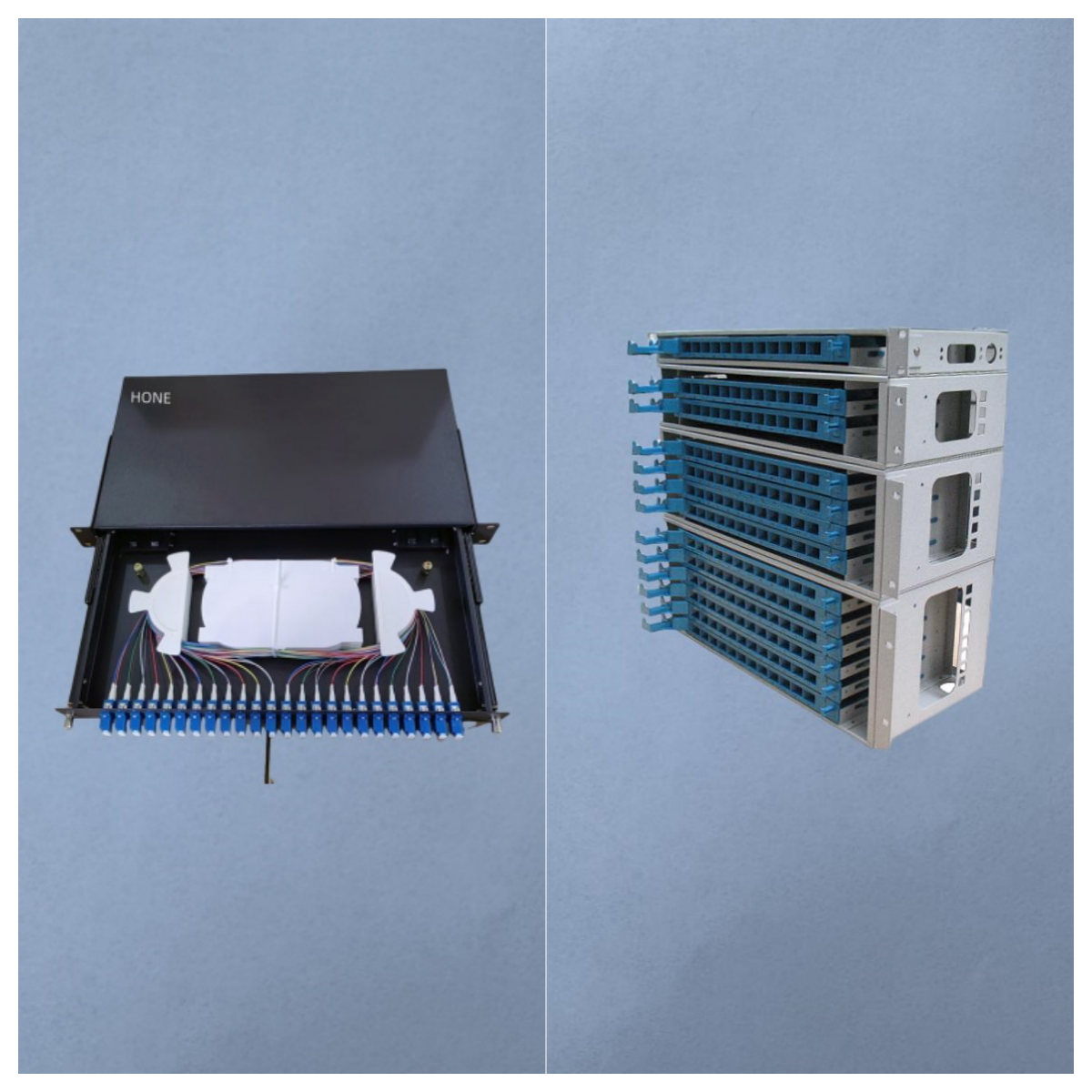
When planning a fiber optic network, terms like fiber patch panel and fiber distribution frame (FDF) are often used interchangeably. However, while they serve similar purposes in fiber management, they are not the same device. Understanding the differences between a patch panel and an FDF is essential for choosing the right solution for your network architecture.
This article explains what each device is, how they differ in structure and application, and when to use a patch panel vs an FDF in real-world fiber optic deployments.
If you are not familiar with the basic role of a fiber patch panel, you may want to read our pillar guide first:
What Is a Fiber Optic Patch Panel and How Does It Work?
What Is a Fiber Optic Patch Panel?
A fiber optic patch panel is a compact fiber management device used to terminate, organize, and interconnect fiber optic cables. It typically holds adapters (such as LC or SC) that allow patch cords to connect network equipment to backbone or distribution fibers.
Key Characteristics of Fiber Patch Panels
- Compact and space-efficient
- Designed for frequent patching and reconfiguration
- Available in rack mount or wall mount designs
- Commonly used at the access or distribution layer
Patch panels are widely used in data centers, enterprise networks, telecom rooms, and FTTH distribution points where flexibility and ease of maintenance are required.
What Is a Fiber Distribution Frame (FDF)?
A fiber distribution frame (FDF) is a larger and more robust fiber management system designed to handle high fiber counts and centralized fiber termination. FDFs are often floor-standing or large rack-based frames used in telecom central offices and major network hubs.
Key Characteristics of FDFs
- Supports very high fiber density
- Designed for long-term, stable fiber routing
- Emphasizes physical protection and structured cable paths
- Typically used at the core network level
Unlike patch panels, FDFs are not primarily designed for frequent changes. Instead, they focus on permanent fiber routing, protection, and clear separation of incoming and outgoing fibers.
Patch Panel vs FDF: Structural Differences
1. Size and Density
- Patch Panel: Compact, usually 1U–4U in a rack; suitable for low to medium fiber counts.
- FDF: Large-scale frame or cabinet; supports hundreds or even thousands of fibers.
2. Installation Environment
- Patch Panel: Server rooms, equipment racks, wall-mounted locations.
- FDF: Central offices, carrier-grade facilities, main distribution rooms.
3. Cable Management Style
- Patch Panel: Focuses on front-access patching and quick changes.
- FDF: Uses structured routing, vertical and horizontal organizers, and clear fiber paths.
Functional Differences in Real Networks
Flexibility vs Stability
- Patch Panels are ideal where connections change frequently, such as equipment upgrades or reconfiguration.
- FDFs prioritize stability and long-term fiber organization with minimal changes.
Maintenance and Operation
- Patch panels allow quick troubleshooting and port-level access.
- FDFs are designed to reduce accidental fiber disturbance by separating working zones.
Typical Application Scenarios
When to Use a Fiber Patch Panel
- Data centers and enterprise networks
- Access and aggregation layers
- FTTH distribution points
- Small to medium fiber counts
- Projects requiring frequent reconfiguration
When to Use a Fiber Distribution Frame (FDF)
- Telecom central offices
- Core network locations
- Large-scale backbone fiber management
- High fiber density environments
- Long-term, stable network infrastructure
Patch Panel and FDF in the Same Network
In many large networks, patch panels and FDFs are used together rather than as alternatives.
A common architecture looks like this:
- FDF at the core: manages incoming backbone fibers
- Patch Panels downstream: handle distribution to equipment and access networks
This layered approach improves scalability, organization, and maintenance efficiency.
How to Choose Between a Patch Panel and an FDF
Ask yourself the following questions:
- How many fibers need to be managed?
High fiber counts usually require an FDF. - How often will connections change?
Frequent changes favor patch panels. - Where is the installation located?
Limited space environments are better suited to patch panels. - Is this a core or access network?
Core networks typically rely on FDFs, while access networks use patch panels.
Conclusion
While both fiber patch panels and fiber distribution frames play essential roles in fiber optic networks, they are designed for different scales and purposes. Patch panels emphasize flexibility and accessibility, while FDFs focus on high-density, structured, and long-term fiber management.
Understanding the differences between a patch panel and an FDF allows network designers, engineers, and project managers to build fiber infrastructures that are both efficient and future-proof.




 English
  Español