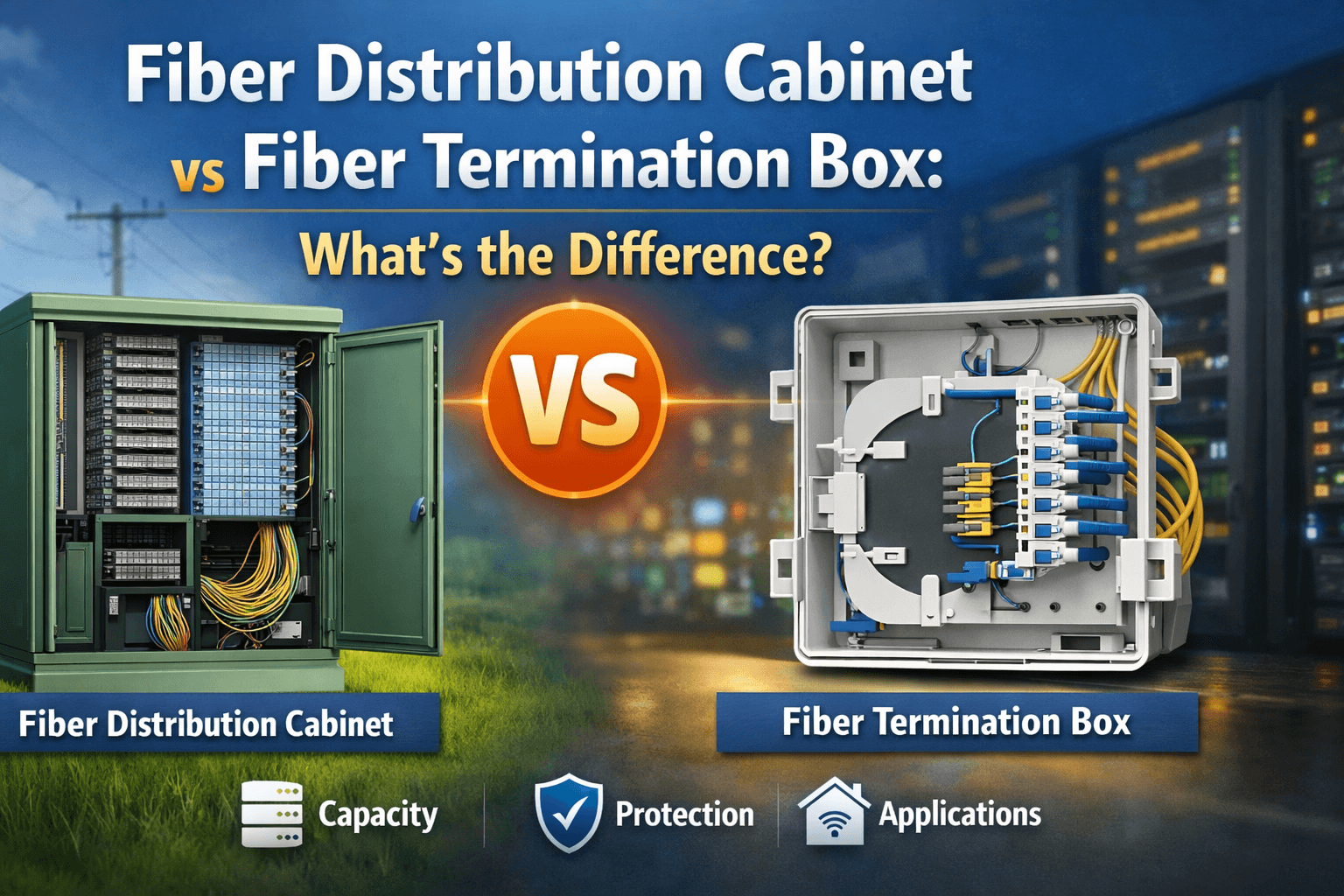
Fiber Distribution Cabinet vs Fiber Termination Box
In fiber optic networks, choosing the right equipment for cable management and distribution is essential for ensuring performance, scalability, and long-term reliability. Two commonly used components are fiber distribution cabinets and fiber termination boxes.
Although they may appear similar at first glance, these two devices serve very different purposes within a network. Understanding their differences is critical for engineers, contractors, and network planners working on FTTH, telecom, and broadband infrastructure projects.
This guide provides a detailed comparison of fiber distribution cabinets and fiber termination boxes, including their structure, functions, applications, and cost differences.
Quick Comparison Overview
| Feature | Fiber Distribution Cabinet | Fiber Termination Box |
|---|---|---|
| Capacity | High (100–1000+ fibers) | Low (4–48 fibers) |
| Installation | Outdoor / network level | Indoor / endpoint |
| Protection | High (IP55–IP65) | Moderate |
| Application | Distribution networks | End-user connection |
| Cost | Higher | Lower |
This table highlights the fundamental differences between the two solutions.
What Is a Fiber Distribution Cabinet?
A fiber distribution cabinet is a large enclosure designed for managing, distributing, and protecting fiber optic cables in outdoor environments. It is typically installed at network distribution points, where backbone cables are connected to access networks.
These cabinets are widely used in FTTH deployments, telecom infrastructure, and municipal broadband systems. They provide structured cable routing, secure fiber splicing, and environmental protection.
What Is a Fiber Termination Box?
A fiber termination box is a compact enclosure used for terminating fiber optic cables at the end-user level. It is commonly installed indoors or in low-capacity outdoor environments.
Termination boxes are typically used in:
- Residential buildings
- Office networks
- Small telecom installations
They provide a simple and cost-effective solution for fiber termination but lack the capacity and protection of distribution cabinets.
Key Differences Explained
1. Capacity and Scalability
Fiber distribution cabinets are designed for high-capacity applications. They can support hundreds or even thousands of fiber connections, making them suitable for large-scale networks.
In contrast, termination boxes are limited to a small number of fiber ports, typically used for individual users or small groups.
2. Environmental Protection
One of the biggest differences lies in protection level.
Fiber distribution cabinets are built for outdoor use and often feature IP65 protection, ensuring resistance to dust, water, and harsh weather conditions.
For outdoor installations, an outdoor fiber cabinet provides superior durability and long-term reliability.
Termination boxes, on the other hand, offer limited protection and are mostly used indoors or in sheltered environments.
3. Installation Location
- Fiber distribution cabinets → roadside, outdoor, network nodes
- Fiber termination boxes → indoor walls, residential units
This difference directly affects design, materials, and cost.
4. Functionality
Fiber distribution cabinets support:
- Fiber splicing
- Cable branching
- High-density distribution
- Network expansion
Termination boxes mainly support:
- Fiber termination
- Basic cable management
Application Scenarios
When to Use a Fiber Distribution Cabinet
Use a distribution cabinet when:
- Deploying FTTH networks
- Managing high fiber counts
- Installing outdoor infrastructure
- Planning for future expansion
When to Use a Fiber Termination Box
Use a termination box when:
- Connecting end users
- Installing indoor networks
- Handling low fiber counts
Cost Comparison
| Factor | Cabinet | Box |
|---|---|---|
| Material | Higher | Lower |
| Installation | Complex | Simple |
| Maintenance | Moderate | Easy |
Although cabinets are more expensive, they provide better scalability and protection, making them more cost-effective for large networks.
Long-Term Performance Considerations
Fiber distribution cabinets offer better long-term performance due to:
- Stronger materials
- Better sealing
- Higher capacity
Termination boxes may require replacement or upgrades as network demand grows.
Conclusion
Fiber distribution cabinets and fiber termination boxes serve different roles in fiber networks. Cabinets are ideal for large-scale outdoor distribution, while termination boxes are suitable for small-scale indoor applications.
Understanding these differences helps ensure efficient network design and long-term reliability.




 English
  Español