Introduction
Deploying fiber in an apartment building is very different from connecting a single-family home. In a residential FTTH rollout, one customer usually means one drop cable and one termination point. In a multi-dwelling unit (MDU), a single building can require dozens—or even hundreds—of fiber connections, all routed through shared corridors, riser shafts, and telecom closets.
That’s why choosing the right fiber termination box for an apartment building is not a small decision. If the box is undersized, poorly placed, or difficult to maintain, the result is usually the same: messy routing, tight bends, rework, and service interruptions during upgrades.
This guide explains how a termination box is used in apartment buildings, where it is typically installed, how to size it correctly, and what to consider for long-term maintenance in MDU FTTH networks.
What Is a Fiber Termination Box in an Apartment FTTH Network?
In an apartment building, a termination box is the enclosure where feeder fiber, distribution fiber, and subscriber drop cables are brought together and organized. It may contain:
- Splice trays for fiber splicing
- Adapter ports for SC/LC connectors
- Fiber routing channels
- Slack storage for pigtails and drop fibers
- Optional PLC splitter space (in some designs)
You may also see this enclosure called a fiber optic terminal box depending on the region and customer preference. In practice, both terms refer to the same type of FTTH endpoint enclosure used to terminate, protect, and route fiber connections.
Why Apartment Buildings Need Different Termination Box Planning
Apartment FTTH projects create unique engineering problems:
1) High connection density
Instead of 1–2 subscriber connections, you may need 8, 16, 24, or more connections per floor.
2) Shared routing pathways
Cables run through risers, corridors, ceilings, and shared conduits. Any poor routing affects multiple customers.
3) Limited installation space
MDU telecom spaces are often tight. Enclosures must be compact but still serviceable.
4) Frequent upgrades and changes
New tenants, new ISPs, and fiber upgrades happen constantly. A termination point must be easy to reopen, re-route, and expand.
That is why many network planners start by looking at the complete termination box for fiber optic cable strategy—meaning not only the box itself, but also where it fits into the building distribution architecture.
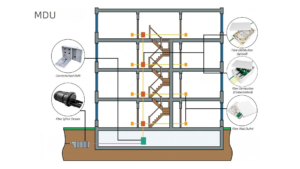
Typical Termination Box Locations in Apartment Buildings
Apartment buildings can be designed in different ways depending on the country, ISP, and building layout. However, most MDU FTTH deployments use one of the following termination layouts.
Option A: Floor-by-Floor Termination Points (Most Common)
In this model, a termination box is installed on each floor, usually in:
- corridor telecom cabinet
- stairwell access area
- utility closet
From that floor termination point, drop cables are routed to each apartment unit on the same floor.
This approach reduces drop cable length, makes troubleshooting faster, and prevents a single central box from becoming overcrowded.
Option B: Central Basement Termination Point (Simplified Architecture)
Some buildings use a large termination enclosure in the basement or main telecom room. From there, fibers are distributed vertically to floors using riser cables.
This can reduce the number of termination boxes needed, but it requires careful vertical routing and often results in more complex maintenance when multiple floors share one termination location.
Option C: Hybrid (Basement + Floor Sub-Boxes)
In many modern apartment FTTH deployments, the building uses:
- a main distribution point in the basement
- smaller termination boxes on each floor
This hybrid approach balances capacity, installation efficiency, and maintenance accessibility.
Capacity Planning for MDUs (The #1 Mistake in Apartment FTTH)
The most common failure in MDU termination box selection is choosing a box based on port count only.
For example, a box labeled “16 ports” may not truly support 16 subscriber drops if:
- splice tray space is limited
- routing channels are too narrow
- slack storage is insufficient
- bend radius is not protected
- splitter pigtails occupy most internal space
A correct MDU design should always start with realistic capacity planning. If you want the detailed method, see our guide on fiber optic termination box capacity planning, which explains how to calculate ports, splices, and routing space in real projects.
How Many Ports Do You Need per Floor?
There is no single answer, but here are common patterns:
Small apartments (4–8 units per floor)
- 8-port termination box
- 12-port termination box (recommended for spare capacity)
Medium apartments (8–16 units per floor)
- 16-port termination box
- 24-port termination box if upgrades are expected
Large MDUs (16–32 units per floor)
- 24-port or 48-port distribution approach
- often combined with splitter-ready design
High-rise buildings
- typically use multiple termination points per floor or per zone
- may include separate enclosures for splitters and terminations
In many cases, installers intentionally oversize by 20–30% to allow for re-termination, spare ports, and future expansion.
Splice Management and Fiber Routing in MDUs
Apartment buildings are unforgiving when it comes to messy fiber routing. Once the building is occupied, technicians cannot easily rework the installation without disrupting tenants.
A good termination box for an MDU must support:
- clear incoming cable entry points
- separate routing channels for feeder and drop fibers
- proper slack storage
- strong bend radius control
- stable splice tray design
This is where fiber termination quality becomes critical. Poor routing and uncontrolled slack storage often cause microbending and long-term attenuation issues—even when the initial OTDR test passes.
Should Apartment Termination Boxes Include PLC Splitters?
In many PON networks, PLC splitters are placed in upstream distribution cabinets. But in some apartment projects, splitters are integrated closer to the subscriber side.
This can be useful when:
- you want fewer upstream distribution points
- you want a compact deployment per floor
- the building has limited telecom rooms
- the ISP wants modular upgrades floor-by-floor
However, splitter integration requires extra space and careful routing for splitter pigtails.
If your MDU project requires splitter-ready enclosures, you should use a design specifically made for optical fibre termination box with PLC splitter accommodation, rather than forcing a standard termination box to fit a splitter.
Indoor vs Outdoor: A Common Apartment Deployment Reality
Many people assume apartment termination boxes are always indoor. In reality, a lot of buildings require termination points in semi-exposed environments, such as:
- basement areas with humidity
- parking levels
- external wall entry points
- stairwell access zones with dust and temperature variation
In these cases, you must choose the correct enclosure type and protection rating. Otherwise, condensation and dust can damage connectors, reduce long-term performance, and create repeated maintenance calls.
For a detailed comparison, see our guide on indoor vs outdoor fiber optic termination box selection.
Fire Safety, Cable Type, and Building Compliance
Apartment buildings often have strict fire safety regulations, especially in:
- corridors
- riser shafts
- shared telecom rooms
This affects:
- drop cable jacket type (LSZH is common)
- enclosure material
- labeling requirements
- installation practices
Even if the termination box is technically correct, using the wrong cable jacket or poor routing through fire-rated spaces can create compliance issues.
For B2B buyers, this is often a key purchasing factor—especially for European and Middle East FTTH tenders.
Maintenance Tips: What Technicians Actually Need
A termination box in an apartment building will be opened many times over its lifetime. Therefore, it should support:
- tool-friendly access (not fragile snap locks)
- stable splice tray rotation or flip design
- clear port labeling
- durable adapter mounting
- sufficient slack storage for re-termination
In long-term MDU projects, the best enclosures are the ones that make routine maintenance simple—not the ones that only look compact in the catalog.
This is one reason many contractors prefer enclosures designed for fibre optic termination work in the field, with clear routing and strong bend radius protection.
Common Mistakes in Apartment FTTH Termination Box Selection
Here are the top mistakes we see in real deployments:
Choosing by port count only
Port count is not capacity. Routing space matters.
No spare capacity
MDU projects almost always expand.
Poor bend radius control
This causes long-term attenuation issues.
Using indoor boxes in humid basements
Moisture and dust eventually damage connectors.
No labeling strategy
Troubleshooting becomes slow and error-prone.
Splitter integration without planning
Splitters occupy space and require proper pigtail routing.
Recommended MDU Termination Box Checklist
Before choosing a termination box for an apartment building, confirm:
- Port count matches subscriber plan
- Splice tray supports required splices
- Routing channels support clean fiber management
- Drop cable entries match floor layout
- Optional splitter space is available if required
- Enclosure type matches indoor/outdoor exposure
- Maintenance access is easy and repeatable
- Labeling area is sufficient
This checklist alone prevents most deployment issues.
Conclusion
Apartment building FTTH projects require more than a basic termination enclosure. The correct fiber termination box must support high-density routing, reliable splice management, expansion readiness, and easy long-term maintenance.
By planning termination points based on subscriber density, routing pathways, splitter requirements, and installation environment, network teams can build MDU FTTH systems that remain clean, stable, and serviceable for years.




 English
  Español