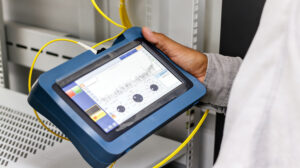
Testing underground fiber optic cable after installation is a critical step in ensuring network performance, reliability, and long-term stability. Even when cables are installed correctly, issues such as microbending, improper splicing, or hidden damage can affect signal transmission.
Because underground fiber systems are not easily accessible after burial, post-installation testing is essential to detect potential problems before the network goes live.
For a complete understanding of underground cable structures and installation environments, refer to underground fiber optic cable design standards and deployment practices
which explains how different cable types are used in buried infrastructure.
Why Testing Underground Fiber Is Important
Underground fiber cables operate in environments where maintenance and repair are costly. Identifying issues early helps avoid expensive rework and network downtime.
Testing ensures:
- Signal integrity across the network
- Proper splicing and connector performance
- Compliance with design specifications
- Detection of hidden installation damage
Many post-installation issues fall under typical underground fiber optic cable failure causes and troubleshooting methods which can often be prevented through proper testing procedures.
Types of Fiber Optic Testing Methods
Several testing methods are used after underground fiber installation. Each method serves a different purpose.
1. Visual Inspection
Before using testing equipment, a basic visual inspection is performed.
Inspectors check for:
- Cable damage
- connector cleanliness
- proper labeling
- installation quality
Although simple, this step helps identify obvious issues before advanced testing begins.
2. Continuity Testing
Continuity testing verifies that the fiber path is complete and uninterrupted.
This test confirms:
- No breaks in the fiber
- Proper end-to-end connection
It is often the first step before more detailed measurements.
3. Optical Power Loss Testing (OLTS)
Optical Loss Test Set (OLTS) measures signal loss across the fiber link.
This method evaluates:
- insertion loss
- connector performance
- splice quality
Accurate loss measurement is critical for ensuring network performance, especially in long-distance deployments where attenuation accumulates.
In large infrastructure projects, engineers working on long distance underground fiber optic cable transmission systems and performance optimization rely heavily on loss testing to validate link quality.
4. OTDR Testing (Optical Time Domain Reflectometer)
OTDR testing is one of the most important methods for underground fiber networks.
It works by sending light pulses through the fiber and measuring reflections.
OTDR can identify:
- splice points
- bends and losses
- breaks or faults
- fiber length
This method is especially useful for underground cables because it allows technicians to locate problems without excavation.
OTDR Testing for Underground Fiber
OTDR is widely used in underground fiber testing because of its ability to detect hidden issues.
Key Benefits
- Fault location without digging
- Detailed signal analysis
- Identification of microbending or macrobending
- Verification of splice quality
Improper installation conditions such as tight bending can be detected during testing. Engineers often consider minimum bending radius requirements for underground fiber optic cable installation when analyzing OTDR results.
OTDR Testing Process
Typical OTDR testing steps include:
- Connect OTDR to fiber cable
- Set wavelength and range
- Launch test signal
- Analyze trace results
- Identify anomalies
Technicians interpret OTDR graphs to locate faults and evaluate signal quality.
Testing After Different Installation Methods
Direct Burial Testing
Direct burial cables are more exposed to environmental stress and mechanical pressure.
Testing must confirm that installation did not introduce hidden damage.
In these cases, installers often follow direct burial fiber optic cable testing and installation best practices to ensure proper validation.
Duct Installation Testing
Cables installed in ducts may experience bending or friction during pulling.
Testing helps verify that:
- cable pulling did not cause damage
- bends are within acceptable limits
- connectors are properly installed
Environmental Factors Affecting Test Results
Underground environments can influence test results.
Temperature
Temperature changes affect fiber attenuation.
Moisture
Water ingress can impact cable performance.
Soil Pressure
Long-term pressure may cause microbending.
Proper installation depth is critical to minimize these risks. Engineers follow standard burial depth guidelines for underground fiber optic cable systems to maintain stable operating conditions.
Acceptance Criteria for Fiber Testing
After testing, results are compared against acceptance standards.
Typical criteria include:
- maximum allowable loss per splice
- maximum link attenuation
- acceptable OTDR trace characteristics
Projects must meet these standards before commissioning.
Common Testing Mistakes
1. Skipping OTDR Testing
Only performing basic tests can miss hidden issues.
2. Poor Connector Cleaning
Dirty connectors lead to inaccurate results.
3. Incorrect Test Settings
Wrong wavelength or range can distort data.
4. Ignoring Minor Losses
Small losses may indicate future problems.
Testing Equipment Overview
Common tools used in underground fiber testing include:
- OTDR devices
- optical power meters
- light sources
- inspection microscopes
Selecting reliable equipment ensures accurate test results.
Cost Considerations for Testing
Testing is a small but critical part of total project cost.
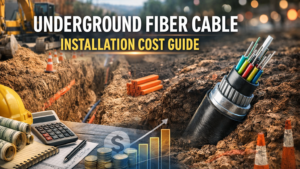
When evaluating budgets, planners often include underground fiber optic cable installation cost estimation and planning factors to account for testing, commissioning, and quality assurance. Skipping testing may reduce short-term cost but increases long-term risk.
Product Considerations for Reliable Testing
Cable quality directly affects test results.
High-quality cables:
- reduce signal loss
- improve splice performance
- enhance long-term reliability
In many projects, contractors select high strength armored fiber optic cable for underground installation projects to ensure stable performance during both installation and testing.
Best Practices for Post-Installation Testing
Perform both OLTS and OTDR testing
Test at multiple wavelengths
Document all results
Verify compliance with standards
Re-test after any repair
Comprehensive testing ensures that underground fiber networks meet performance requirements before operation.
Conclusion
Testing underground fiber optic cable after installation is essential for ensuring network performance and reliability. By using methods such as OTDR testing, power loss measurement, and visual inspection, technicians can identify hidden issues before they affect network operation.
Proper testing, combined with correct installation practices and high-quality cable selection, helps build a robust underground fiber infrastructure capable of long-term service.



 English
  Español