Introduction
In fiber-to-the-home (FTTH) deployments, the access network is designed to bring optical fiber as close as possible to the end user. Between backbone infrastructure and customer premises equipment, multiple enclosures are used to organize, protect, and manage optical fibers. One of the most critical of these enclosures is the FTTH termination box.
An FTTH termination box is installed near the subscriber side of the network and serves as the final fixed enclosure before fiber enters customer premises. Although it may appear simple from the outside, this box plays a key role in ensuring fiber integrity, signal stability, and long-term maintainability. Misunderstanding its function often leads to poor enclosure selection, crowded fiber routing, and avoidable field issues.
This article explains what an FTTH termination box is, how it is used in access networks, and why it is a fundamental component in modern FTTH design.
The Role of an FTTH Termination Box in Access Networks
Within an FTTH architecture, fibers typically pass through several stages: feeder cables, distribution points, and finally termination at or near the subscriber. The FTTH termination box defines the point where fibers are prepared for final connection.
In practical terms, it acts as the organized endpoint for subscriber fiber connections, allowing technicians to perform splicing, connector termination, and fiber storage in a controlled environment rather than in open space.
This enclosure helps separate permanent network infrastructure from customer-side cabling. Once installed, the termination box remains fixed, while drop cables or patch cords can be connected, disconnected, or replaced without disturbing upstream fibers. This separation is especially important in residential FTTH projects where subscriber turnover is frequent.
Key Components Inside an FTTH Termination Box
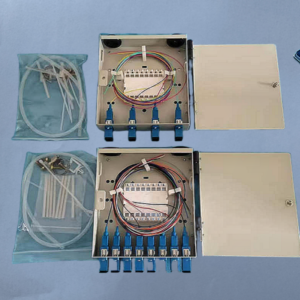
Although designs vary by manufacturer and capacity, most FTTH termination boxes share a similar internal structure. Typical components include splice trays, fiber routing channels, adapter panels, and cable fixation points.
One of the primary design goals is efficient fiber management within compact spaces. Because termination boxes are often installed in apartments, corridors, or outdoor walls, available space is limited. Proper internal routing ensures minimum bend radius compliance, reduces micro-bending loss, and keeps fibers clearly identifiable during maintenance.
Clear separation between incoming feeder fibers and outgoing drop fibers also helps prevent accidental damage during installation or troubleshooting. Labels, routing guides, and splice protection sleeves all contribute to orderly fiber organization inside the enclosure.
FTTH Termination Boxes and Optical Splitters
In many FTTH network designs, optical splitters are deployed upstream at distribution points. However, depending on network topology and subscriber density, splitters may also be integrated closer to the end user.
Some FTTH termination boxes are designed to support splitter accommodation at the access node, allowing fiber signals to be divided within or directly adjacent to the termination enclosure. This approach can reduce the number of intermediate boxes and simplify cable routing in low-density or customized deployments.
When splitters are involved, internal space planning becomes even more critical. Adequate routing paths and mounting positions are required to maintain fiber order and accessibility, especially when future subscribers may be added.
Installation Locations and Field Deployment
FTTH termination boxes can be installed in various locations depending on network design and building structure. Common installation sites include apartment corridors, utility rooms, building facades, and pole-mounted positions in outdoor environments.
From a field perspective, installers pay close attention to installation points close to subscriber premises, as shorter drop cable lengths help minimize signal attenuation and reduce installation time.
Mounting height, cable entry direction, and accessibility are also important considerations. A well-installed termination box allows technicians to perform future work without disrupting surrounding cables or requiring enclosure relocation.
Capacity Planning and Future Expansion
Selecting an FTTH termination box is not only about current subscriber needs. Capacity planning plays a crucial role in ensuring the network can grow without repeated rework.
Engineers often evaluate matching termination box capacity with network growth plans, taking into account the number of fibers, splice positions, and connector ports required over time.
Overcrowded termination boxes increase the risk of fiber damage and make troubleshooting more difficult. Slightly oversizing capacity at the design stage often leads to lower operational costs throughout the network lifecycle.
FTTH Termination Box vs Other Fiber Enclosures
It is important not to confuse FTTH termination boxes with other fiber enclosures such as distribution boxes or cross-connect cabinets. While all these products manage fiber, their roles in the network are distinct.
Termination boxes focus on final fiber handling near the subscriber, while distribution boxes manage routing and splitting for multiple downstream connections. Understanding this distinction helps designers avoid placing overly complex enclosures where a simple termination solution would be more effective.
Conclusion
An FTTH termination box is a fundamental element in access network design. It provides a secure, organized environment for final fiber termination, protects delicate optical fibers, and enables efficient installation and maintenance at the subscriber side.
By understanding its role, structure, installation requirements, and capacity considerations, network designers and installers can build FTTH systems that are scalable, reliable, and easier to maintain over the long term.



 English
  Español