In today’s high-speed networking environment, flexibility and scalability are more important than ever. Whether you’re working on a telecom backbone, enterprise network, or FTTH deployment, one component you’ll frequently encounter is the SFP module.
But what exactly is it, and why is it so widely used?
This guide will walk you through everything you need to know—from the basics to practical selection tips—so you can confidently use SFP modules in your network.
What Is an SFP Module?
An SFP (Small Form-factor Pluggable) module is a compact, hot-swappable transceiver used to connect network devices like switches and routers to fiber optic or copper cables.In modern network upgrades, 10G SFP+ modules for scalable bandwidth expansion in enterprise switching and aggregation layers are widely used to support growing traffic demands without redesigning the entire infrastructure.
Instead of having fixed ports, networking equipment uses SFP slots, allowing you to insert different modules depending on your needs. This makes network upgrades and maintenance much more flexible.
If you’re just getting started, understanding what an SFP transceiver module is and how it is used in networking can give you a solid foundation before diving into more advanced topics.
Why SFP Modules Matter in Modern Networks
SFP modules have become a standard in fiber optic communication for several key reasons.
First, they allow network engineers to adapt quickly to different transmission requirements. Whether you need short-distance connections inside a data center or long-distance links across cities, SFP modules make it possible without changing the entire device.
Second, they significantly reduce costs. Instead of replacing expensive switches, you can simply swap out modules.
Finally, their hot-swappable design means you can replace or upgrade them without shutting down the system—something critical for maintaining uptime in business environments.
How Does an SFP Module Work?
At a basic level, an SFP module acts as a translator between electrical and optical signals.
When a switch sends data, it is in electrical form. The SFP module converts that signal into light, which travels through a fiber optic cable. At the receiving end, another module converts the light back into an electrical signal.
If you want a deeper look into the internal process, including signal conversion and transmission flow, it helps to explore how an SFP module works in fiber optic communication systems.
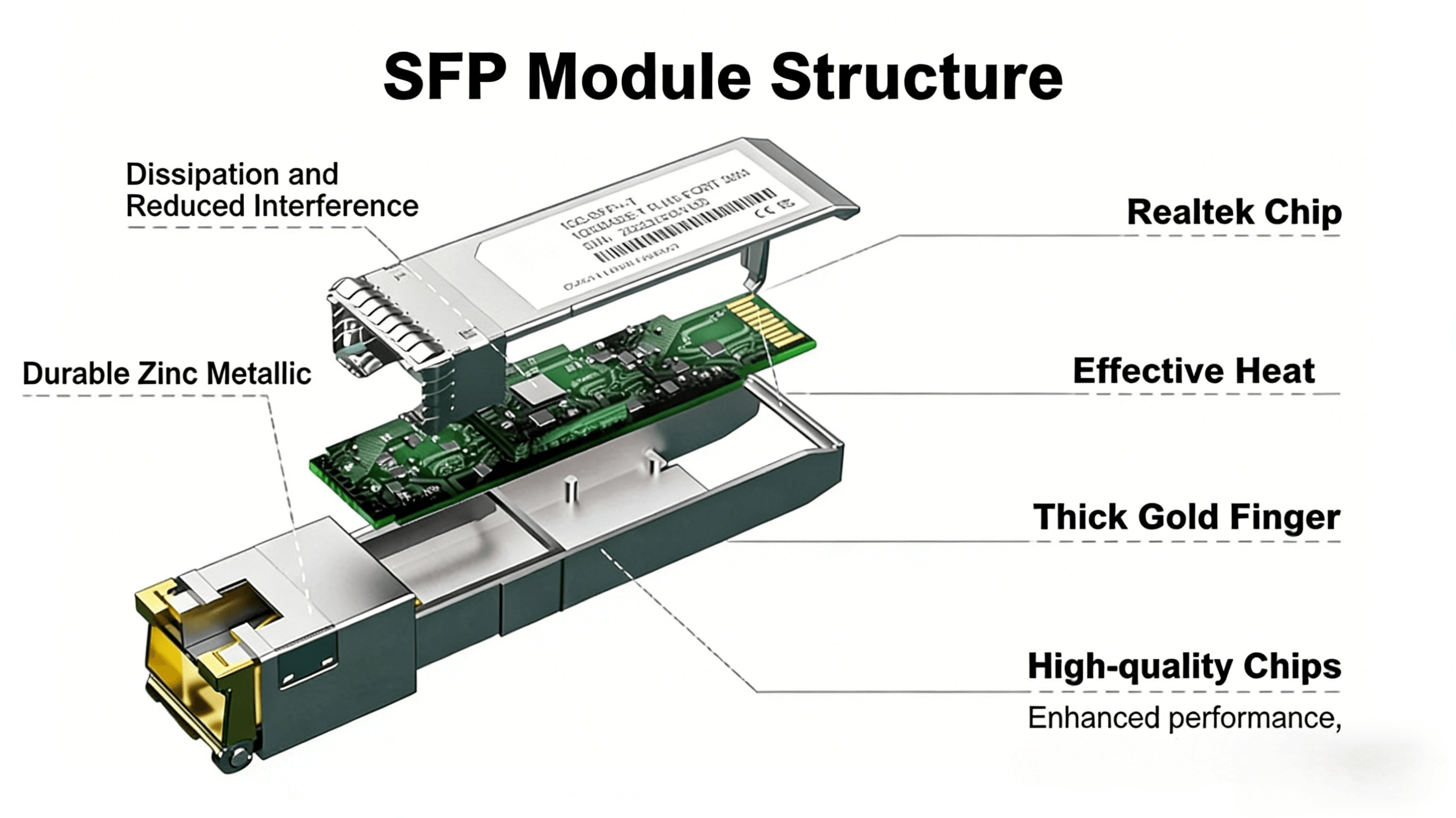
Key Components Inside an SFP Module
Although small in size, SFP modules contain several critical components:
- Laser diode or LED for transmitting optical signals
- Photodetector for receiving signals
- LC interface for fiber connection
- EEPROM chip for storing configuration data
- Metal housing for protection and heat dissipation
These components work together to ensure stable and high-speed data transmission across fiber networks.
Types of SFP Modules
SFP modules are not one-size-fits-all. They vary depending on distance, fiber type, and application.
By Fiber Type
- Single-mode SFP (SMF) – suitable for long distances (up to 120 km)
- Multi-mode SFP (MMF) – ideal for short distances (up to 550 m)
By Speed
- 1G SFP
- 10G SFP+
- 25G SFP28
By Wavelength
- 850nm (commonly for MMF)
- 1310nm and 1550nm (for SMF)
If you’re comparing options for a project, reviewing different types of SFP modules and when to use each one can make the selection much clearer.
SFP vs SFP+: What’s the Difference?
One of the most common questions is whether to use SFP or SFP+.
The main difference lies in speed. Standard SFP modules support up to 1Gbps, while SFP+ modules can handle up to 10Gbps, making them more suitable for high-bandwidth environments like data centers.
However, compatibility and cost should also be considered. Not all devices support both types interchangeably.
To better understand real-world differences, including performance and deployment scenarios, you can read about the key differences between SFP and SFP+ modules in networking.
Understanding SFP Module Compatibility
Compatibility is one of the most overlooked aspects when choosing an SFP module.
Different manufacturers often use proprietary coding, which means not every SFP module will work with every switch or router. Even if the specifications match, incompatibility can still cause connection failures.
Before purchasing, it’s a good idea to check how to ensure SFP module compatibility with various network switches and brands to avoid unnecessary issues.
How to Choose the Right SFP Module
Choosing the correct SFP module depends on several practical factors.
Transmission Distance
Short distances within buildings usually require multimode modules, while long-distance links require single-mode solutions.
Data Rate
Make sure the module matches your network speed—1G, 10G, or higher.
Fiber Type
Always match the module with your existing fiber infrastructure.
Device Compatibility
Check whether your switch supports third-party modules.
If you’re unsure where to start, this guide on how to choose the right SFP module for your network requirements provides a step-by-step approach.
Common Applications of SFP Modules
SFP modules are used across a wide range of industries:
- Data centers – for high-speed server connections
- Telecommunications – in backbone and access networks
- FTTH/FTTX deployments – connecting end users to fiber networks
- Enterprise networks – enabling flexible infrastructure upgrades
Their versatility makes them a core component in modern communication systems.As network architectures evolve, high-capacity deployments often rely on 100G QSFP28 optical transceivers for backbone network scaling and high-volume data aggregation in cloud infrastructure environments to meet increasing bandwidth demands.
Advantages of Using SFP Modules
Flexibility
Easily switch between different transmission types and distances
Cost Efficiency
Replace only the module instead of the entire device
Easy Maintenance
Hot-swappable design reduces downtime
Scalability
Supports future upgrades without major infrastructure changes
Common Issues and Troubleshooting Tips
No Link Detected
- Check fiber connections
- Verify compatibility
Signal Loss
- Ensure correct distance specification
- Inspect cable quality
Module Not Recognized
- Confirm vendor support
- Update firmware if necessary
Conclusion
SFP modules are a fundamental part of modern fiber optic networking. Their flexibility, scalability, and cost-effectiveness make them an ideal solution for a wide range of applications.
By understanding how they work, the different types available, and how to choose the right one, you can build a more reliable and efficient network.
If you’re planning a deployment or upgrading your infrastructure, exploring fiber optic SFP modules for different network applications and distances is a good next step to find the right solution.





 English
  Español