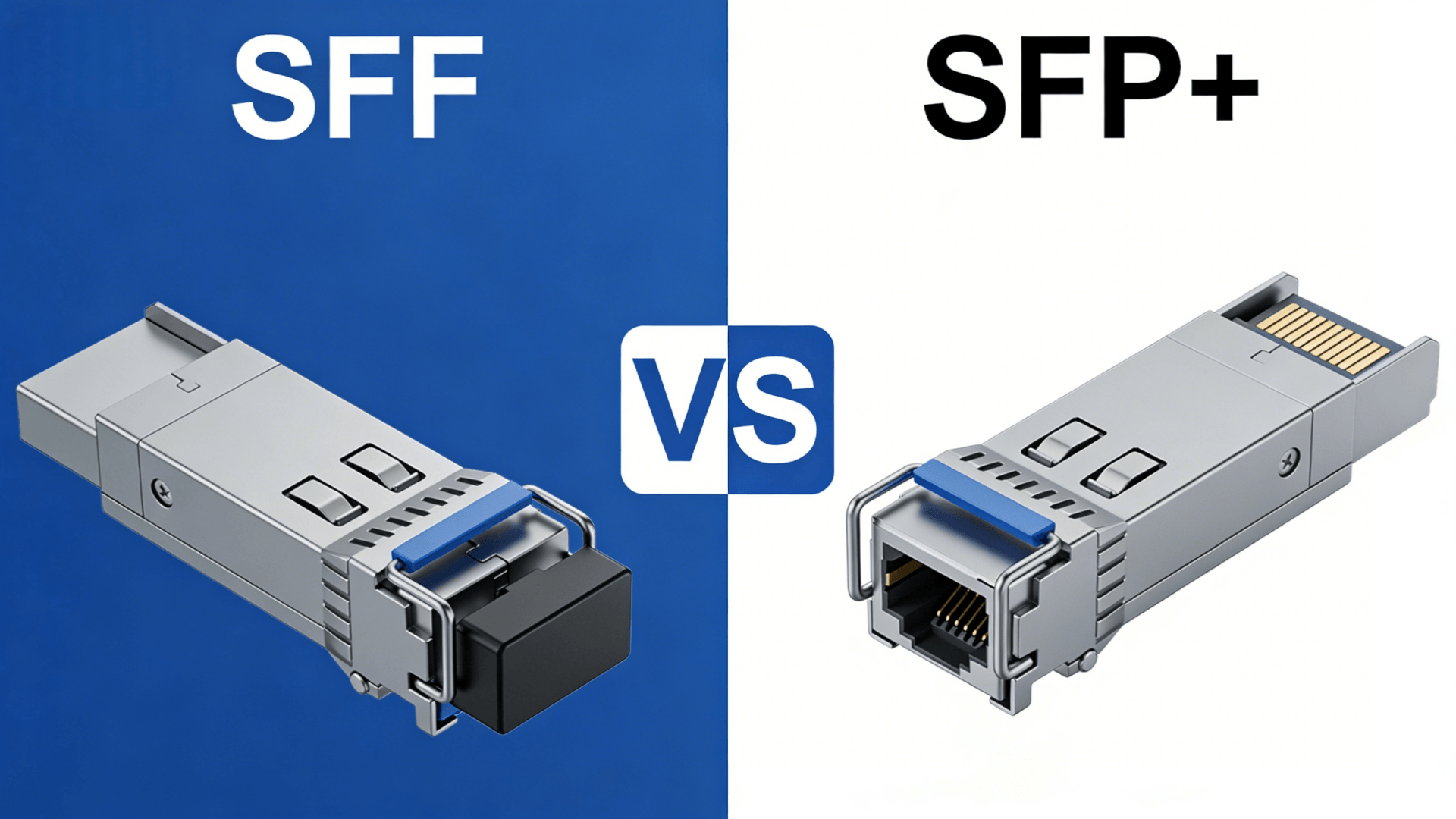
SFP vs SFP+: Quick Answer
The main difference between SFP and SFP+ is speed and performance.
- SFP supports up to 1Gbps
- SFP+ supports up to 10Gbps
- SFP+ relies more on the host device for signal processing
- SFP is more compatible with older network equipment
If you’re deciding between the two, SFP is suitable for basic networks, while SFP+ is designed for high-speed applications.
SFP vs SFP+: Comparison Table
| Feature | SFP | SFP+ |
|---|---|---|
| Max Speed | 1 Gbps | 10 Gbps |
| Compatibility | SFP ports | SFP+ ports |
| Backward Use | Yes (in SFP+) | No |
| Cost | Lower | Higher |
| Use Case | Standard networks | High-speed networks |
What Is SFP?
SFP (Small Form-factor Pluggable) is a compact optical transceiver used for data transmission at speeds up to 1Gbps.
It is commonly used in enterprise networks, access layers, and legacy systems where ultra-high speed is not required.
If you want a deeper understanding, you can explore what an SFP module does in fiber optic communication systems.
What Is SFP+?
SFP+ is an enhanced version of SFP designed for higher-speed data transmission, typically up to 10Gbps.
It is widely used in data centers, aggregation layers, and backbone networks where performance is critical.
Key Differences Between SFP and SFP+
1. Speed
The most important difference is speed.
- SFP: up to 1Gbps
- SFP+: up to 10Gbps
This makes SFP+ the preferred choice for high-bandwidth environments. In real-world deployments, many engineers rely on 10G SFP+ modules for high-speed data transmission between switches and servers to ensure stable performance and avoid network bottlenecks.
2. Signal Processing
SFP modules handle more processing internally, while SFP+ modules rely on the host device.
Understanding how SFP modules convert electrical signals into optical signals during transmission can help explain why SFP+ achieves higher performance.
3. Compatibility
Compatibility is a major factor when choosing between SFP and SFP+.
- SFP modules can often work in SFP+ ports (at lower speed)
- SFP+ modules usually do not work in SFP ports
Because of this, engineers often check how to avoid SFP compatibility issues with different switch models before deployment.
4. Cost
SFP modules are more affordable and widely available.
SFP+ modules are more expensive but provide significantly better performance.
5. Applications
SFP is used for:
- Small business networks
- Access layer connections
- Legacy systems
SFP+ is used for:
- Data centers
- High-speed aggregation
- Backbone networks.In large-scale deployments such as data centers and backbone networks, it’s increasingly common to use 100G QSFP28 optical transceivers for high-capacity data center and core network applications to support growing bandwidth demands and future scalability.
To determine the best option, many users refer to how to choose SFP modules based on speed and network requirements.
Can You Use SFP in SFP+ Ports?
Yes — in most cases, SFP modules can be used in SFP+ ports.
However, the speed will be limited to 1Gbps, even if the port supports higher speeds.This is commonly used in mixed or legacy network environments where 10G upgrade is not required yet.
Can You Use SFP+ in SFP Ports?
No — SFP+ modules are generally not compatible with standard SFP ports.
In most cases, they will not be recognized, or the link will fail to establish completely.This is due to hardware and signaling differences between the two module types.
When Should You Choose SFP vs SFP+?
Choose SFP if:
- Your network runs at 1Gbps
- You want a cost-effective solution
- You are using older equipment
Choose SFP+ if:
- You need 10Gbps speed
- You are building a modern network
- You want better scalability
If you’re comparing available options, many buyers prefer exploring reliable SFP and SFP+ modules for enterprise networks, data centers, and telecom applications to ensure compatibility, performance, and long-term stability.
How Module Types Affect Performance
Beyond SFP vs SFP+, different module types also impact performance.
Factors such as wavelength, fiber type, and transmission distance all play a role.
To learn more, check different SFP module types and how they impact distance and performance.
Common Mistakes to Avoid
When choosing between SFP and SFP+, avoid these mistakes:
- Assuming they are interchangeable
- Ignoring compatibility requirements
- Choosing based only on price
- Not planning for future upgrades
FAQ
Is SFP the same as SFP+?
No. SFP supports up to 1Gbps, while SFP+ supports up to 10Gbps.
Which is better, SFP or SFP+?
SFP+ is better for high-speed networks, while SFP is suitable for basic or legacy systems.
Can SFP replace SFP+?
No. SFP cannot replace SFP+ in high-speed applications.
Can SFP+ ports use SFP modules?
Yes, but the speed will be limited to 1Gbps.
Conclusion
SFP and SFP+ may look similar, but they are designed for different performance levels.
SFP is ideal for standard networks, while SFP+ is built for high-speed environments.
By understanding their differences in speed, compatibility, and application, you can choose the right module for your network.





 English
  Español