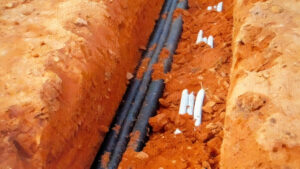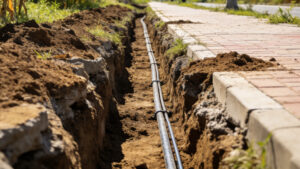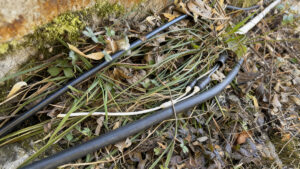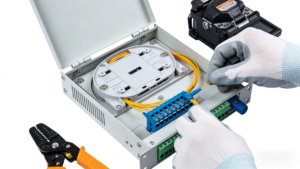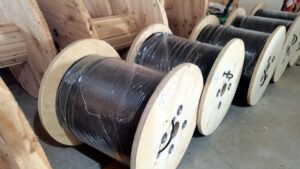
Steel tape armored (STA) fiber optic cable is a reinforced cable structure designed for underground environments where mechanical protection is critical. Unlike standard outdoor cables that rely primarily on jacket thickness and water-blocking materials, STA cables incorporate a corrugated steel tape layer that surrounds the core, forming a physical barrier against compression, rodent damage, and external impact.
In modern broadband infrastructure, especially rural and direct burial deployments, steel tape armoring plays a key role in long-term network stability.
For a broader technical overview of underground structures and deployment environments, refer to the comprehensive guide on underground fiber optic cable types and applications
1. Structure of Steel Tape Armored Fiber Cable
A typical STA underground cable includes:
- Optical fibers (single-mode or multi-mode)
- Loose tube filled with water-blocking gel
- Strength members (FRP or steel wire)
- Inner sheath
- Corrugated steel tape armor layer
- Outer PE or LSZH jacket
The corrugated steel tape is longitudinally wrapped around the inner sheath and sometimes bonded for enhanced rigidity. This metal barrier significantly increases crush resistance compared to non-armored constructions.
2. Why Steel Tape Armor Is Used Underground
Rodent Protection
Rodents are a leading cause of underground cable failure. Standard PE jackets alone cannot reliably prevent gnawing damage in rural areas.
In high-risk zones, contractors often specify rodent resistant fiber optic cable for direct burial applications
because the steel tape layer acts as a mechanical deterrent.
Crush and Impact Resistance
Underground soil pressure, heavy vehicle loads, and accidental digging create compressive forces. Steel tape armor distributes these forces and protects internal fibers from microbending losses.
This becomes especially important in direct burial fiber optic cable construction methods where the cable is not shielded by conduit.
Long-Term Structural Stability
Over time, soil shifting and compaction may stress underground cables. The armored layer enhances dimensional stability and reduces long-term deformation.
3. Steel Tape Armored vs Steel Wire Armored
Steel tape armor (STA) and steel wire armor (SWA) are not identical.
| Feature | Steel Tape Armored | Steel Wire Armored |
|---|---|---|
| Flexibility | Moderate | Lower |
| Crush Resistance | High | Very High |
| Weight | Moderate | Heavy |
| Cost | Lower | Higher |
| Typical Use | Direct burial | Submarine / heavy-duty |
STA is widely used in terrestrial underground networks, while SWA is often selected for high-tension or submarine environments.
If the project involves coastal crossings or marine deployment, cable structures closer to submarine fiber optic cable protection systems may be more appropriate.
4. Installation Considerations
Although armored cables are mechanically stronger, proper installation remains essential.
Maintain Proper Bending Radius
Steel tape reduces flexibility compared to non-armored cables. Installers must respect the minimum bending radius for armored fiber optic cable in trench installations to avoid internal fiber stress.
Grounding Requirements
Because steel tape is conductive, grounding may be required depending on local electrical codes. Proper bonding reduces potential lightning or induced voltage risks.
Burial Depth Coordination
Even with armor protection, depth planning remains critical. Burial depth guidelines for different terrains are outlined in recommended burial depth for underground fiber optic cable and should be considered during route engineering.
5. Advantages of Steel Tape Armored Fiber Cable
High resistance to rodent damage
Improved crush resistance
Suitable for direct burial
Cost-effective compared to SWA
Long service life in rural and agricultural environments
For buyers evaluating structural durability and long-term cost balance, STA cables represent a practical compromise between flexibility and protection.
6. When to Choose Steel Tape Armored Cable
Steel tape armored fiber cable is recommended when:
- Deploying in rural broadband projects
- Installing in rocky or unstable soil
- Avoiding conduit to reduce cost
- Operating in rodent-prone environments
- Extending long-distance backbone routes
In network planning scenarios where conduit systems are not feasible, selecting reinforced cable types aligned with long distance underground fiber optic network deployment standards helps ensure mechanical resilience over extended routes.
7. Common Misconceptions
“Armor Replaces Proper Installation”
Incorrect. Armoring enhances protection but does not eliminate the need for:
- Correct trench bedding
- Warning tape installation
- Utility separation compliance
- Controlled backfill compaction
“Armored Cable Cannot Be Used in Conduit”
Also incorrect. STA cables can be installed inside ducts if additional protection is desired, although flexibility must be considered.
8. Cost Considerations
Steel tape armored cables cost more than non-armored PE jacket cables but significantly less than steel wire armored designs.
The incremental cost is often justified when comparing potential repair expenses from rodent damage or accidental compression failure.
Conclusion
Steel tape armored fiber optic cable is specifically engineered for underground environments where mechanical durability and rodent protection are essential. By incorporating a corrugated steel barrier beneath the outer jacket, STA designs provide enhanced crush resistance while maintaining manageable installation flexibility.
When combined with correct burial depth, controlled bending radius, and proper grounding practices, steel tape armored cables deliver long-term performance in direct burial infrastructure projects.