Summary (for Featured Snippet)
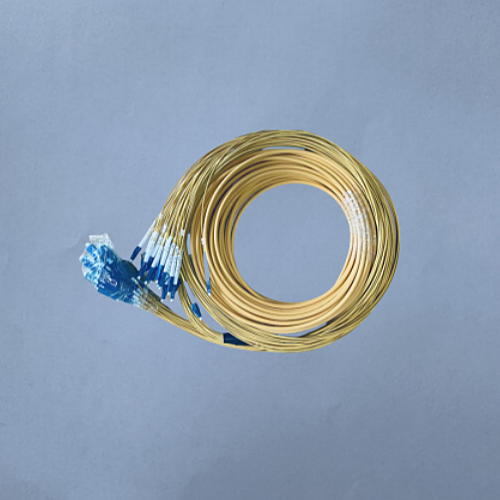
A fiber patch cord—also called a fiber patch cable or optical jumper—is a short-length fiber optic cable with connectors on both ends. It is used to connect network devices such as ODFs, patch panels, switches, media converters, and optical transceivers. Fiber patch cords work by transmitting optical signals through single-mode or multimode fibers with minimal loss, ensuring high-speed and stable communication in data centers, FTTx, telecom rooms, and industrial networks.
What Is a Fiber Patch Cord?
A fiber patch cord is a pre-terminated optical cable designed for fast, flexible, and reliable connections within a fiber optic system. Unlike long-distance fiber optic cables used for outdoor deployment, patch cords are short and are usually used in indoor environments.
They are widely used in environments such as:
- Data centers
- FTTx and FTTH installations
- Telecom central offices
- Enterprise network rooms
- Industrial communication cabinets
- ODF and patch panel fiber management systems
In simple terms, patch cords act as the bridge between active devices (like switches) and passive infrastructure (likeOptical Distribution Frame unit and fiber closures).
How Does a Fiber Patch Cord Work?
A fiber patch cord works by transmitting data as light signals between two points. The working principle depends on three key components:
Optical Fiber
The fiber inside the cable guides light from one connector to the other.
There are two main types:
| Fiber Type | Core Size | Distance | Speed | Typical Use |
| Single Mode (OS2) | 9/125 μm | Long distance (up to 40–100 km) | High | Telecom, FTTx |
| Multimode (OM2/OM3/OM4/OM5) | 50/125 μm or 62.5/125 μm | Short distance (≤500 m) | Very High | Data centers, LAN |
Fiber Connectors
Connectors enable quick plug-and-play fiber connections.
Common types include:
- LC – small form, most used in data centers
- SC – push-pull connector, widely used in ODF and FTTH
- FC – screw-type, used in industrial environments
- ST – bayonet type, older systems
Transceivers & Equipment
The patch cord connects to a transceiver module (SFP, SFP+, QSFP, etc.) or network terminal.
Light travels in one or two directions depending on:
- Simplex fiber → Single fiber, one-way
- Duplex fiber → Two fibers, full-duplex communication
Thus, a fiber patch cord works by creating a loss-controlled optical channel between two network devices.
Types of Fiber Patch Cords (Complete Guide)
By Connector Type
- LC to LC
- SC to SC
- LC to SC
- FC to FC
- ST to LC / ST to SC
- MPO/MTP high-density
By Fiber Mode
- Single Mode Patch Cord (OS2)
- Multimode Patch Cord (OM2/OM3/OM4/OM5)
By Structure
- Simplex patch cord
- Duplex patch cord
- Multi-fiber MPO/MTP
By Protection Level
- Standard patch cords
- Armored fiber patch cords (protection from crushing, rodents, bending)
- Waterproof outdoor patch cords
By Polishing Type
Polishing affects insertion loss and return loss.
| Polish | Color Code | Use Case |
| UPC | Blue | Common FTTx, ODF |
| APC | Green (8° angle) | Long-distance, OLT/ONT |
| PC | Older systems | Basic networks |
Common Applications of Fiber Patch Cords
Fiber patch cords are used anywhere fiber connectivity is required.
Data Centers
- Connecting switch to ODF
- Connecting servers to TOR switches
- Connecting high-density MPO/MTP networks
FTTx/FTTH Networks
- OLT → Patch Panel
- Patch Panel → Fiber Distribution Box
- ONT → Wall outlet
Telecom Operators
- Central office fiber management
- Backbone connection testing
Industrial Automation
- Harsh environments use armored or waterproof patch cords
Testing & Maintenance
- Used with OTDR, power meters, inspection equipment
Advantages of Fiber Patch Cords
Plug-and-Play Installation
Pre-terminated, no need for fusion splicing.
Low Signal Loss
High-quality connectors and polished ferrules ensure stable transmission.
High Compatibility
Connects with most SFP modules, ODFs, switches, and FTTH boxes.
Flexible and Replaceable
Easy to upgrade or replace without disturbing main trunk cables.
High Reliability
Especially true for armored patch cords—resistant to bending, pressure, and rodents.
How to Choose the Right Fiber Patch Cord
Choosing the correct patch cord is essential for network performance.
Match the Connector Type
Check your equipment labels:
- LC
- SC
- LC-SC hybrid
Choose Fiber Mode
- Use single mode for long-distance or FTTH
- Use multimode (OM3/OM4) for data centers and short links
Consider Simplex or Duplex
- Routers/switches → Duplex
- FTTH ONT → Simplex
Select UPC or APC
- APC (green): FTTH, OLT, ONT, long runs
- UPC (blue): Data centers, LAN
Length & Jacket Material
- Indoor: PVC/LSZH
- Outdoor: TPU/PE
- Harsh environments: Armored
Installation Tips & Best Practices
A high-quality patch cord still requires correct handling.
Avoid Excessive Bending
Minimum bend radius is usually > 10x cable diameter.
Keep Connectors Clean
Dust or grease can cause:
- High insertion loss
- Poor signal quality
- Link failure
Use proper fiber cleaning tools.
Do Not Pull the Cable by the Connector
Always handle by the cable body.
Verify Polarity Before Installation
Especially for duplex and MPO/MTP systems.
Common Problems & How to Avoid Them
Problem 1: High Insertion Loss
Causes: Dirty connectors, tight bends, wrong polishing type
Solution: Clean connectors, re-route cable, match APC/UPC
Problem 2: Incompatible Connectors
LC vs SC confusion is common.
Solution: Always check equipment ports before buying.
Problem 3: Wrong Fiber Mode
Using multimode with single-mode devices leads to poor performance.
Solution: Match OS2 ↔ OS2 and OM3 ↔ OM3
Problem 4: Weak Signal in Outdoor Application
Indoor PVC jackets fail outdoors.
Solution: Use armored or outdoor-rated patch cords.
Conclusion
A fiber patch cord is a crucial component of modern fiber optic networks. It provides a fast, reliable, plug-and-play connection between devices in telecom systems, FTTx, data centers, and industrial networks. Understanding its types, working principles, and correct selection can help ensure stable network performance and reduce failure rates.
If your customers are looking for LC, SC, armored, OM4, or custom-length patch cords, this article positions your website as a professional and authoritative source—ideal for SEO and generating inquiries



 English
  Español