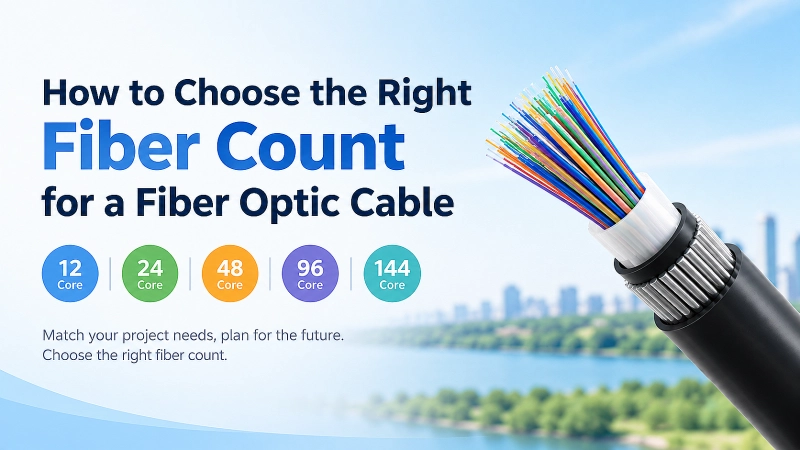
Choosing the right fiber count is not just about deciding between 12, 24, 48, 96, or 144 cores. You need enough fibers for current connections, spare capacity for maintenance, and room for future network expansion without paying for capacity you may never use.
Quick answer: Start by counting the fibers required by your network design, add a planned reserve, and select the next suitable standard cable size. For conventional duplex links, each link normally requires two fibers. Single-fiber BiDi systems and PON architectures may use fibers differently, so confirm the actual network design before calculating.
| Recuento de fibras | Typical applications | Main consideration |
|---|---|---|
| 12 core | Small branches, industrial links, simple access networks | Lower capacity; limited room for growth |
| 24 core | Building backbones, small distribution networks | A practical balance of capacity and cost |
| 48 core | Campus networks, telecom distribution, FTTx routes | More flexibility for multiple connections |
| 96 core | Aggregation networks, larger access networks, backbone links | Supports more branches and spare capacity |
| 144 core | High-density distribution and telecom backbones | Suitable for routes with substantial capacity demand |
These are general planning examples, not fixed rules. A small project may need 48 fibers, while a large project may use several smaller cables on separate routes. The correct choice depends on the number of connections, network topology, redundancy requirements, and future expansion plans.
1. How Many Fibers Do You Actually Need?
Before choosing a cable, answer three questions:
- How many optical connections or services must the route support?
- Does each connection require one fiber or a pair of fibers?
- How many spare fibers should remain available after installation?
For a conventional duplex Ethernet connection, one fiber transmits data and the other receives it. However, BiDi equipment can transmit and receive over a single fiber using different wavelengths. PON networks also require a different calculation because multiple subscribers share optical infrastructure through passive splitters.
Do not simply multiply the number of customers by two. First identify the network architecture and count the fibers required on the specific cable segment being designed.
A simple fiber count formula
For a conventional duplex network:
Required fiber count = Active duplex links × 2 + planned spare fibers
For example, if a backbone must support 10 independent duplex links:
- Active fibers: 10 × 2 = 20
- Planned spare fibers: 4
- Total required: 24 fibers
A 24-core cable meets this calculation. If the project also requires dedicated redundancy, additional network branches, or significant future growth, a 48-core cable may be more appropriate.
For more complex networks, calculate the requirement separately for each cable segment. A backbone carrying traffic for several branches may need more fibers than any individual branch cable.
2. Compare 12, 24, 48, 96, and 144 Core Fiber Optic Cables
The best fiber count depends on how many fibers the route needs, not simply on the overall size of the project.
When should you choose 12 core fiber optic cable?
A 12-core cable can work well for a small network segment with limited connections and modest expansion requirements.
Typical applications include small industrial networks, short building-to-building links, local communication branches, and some utility connections.
For conventional duplex links, 12 fibers provide six fiber pairs before reserving any fibers. If you need four pairs today, you have four fibers remaining for spares or additional services.
Choose 12 cores when the calculated demand is low, the route has limited branching, and future expansion is manageable.
Is 24 core better than 12 core?
A 24-core cable doubles the number of physical fibers available. It provides 12 conventional duplex pairs, making it useful for building backbones, campus connections, and small telecom distribution networks.
Consider a route that initially requires 16 active fibers. A 24-core cable leaves eight spare fibers, while a 12-core cable cannot meet the requirement.
However, doubling the fiber count does not necessarily double the cable diameter or cost. The actual difference depends on tube configuration, strength members, armor, sheath materials, and manufacturing design.
Choose 24 cores when 12 fibers are insufficient or when a modest reserve is important for future services.
When should you choose 48 core fiber optic cable?
A 48-core cable is useful when one route serves several network branches, buildings, cabinets, or communication systems.
For example, a campus backbone might connect administration buildings, workshops, security systems, and distribution cabinets. The route may need separate fibers for current links, future connections, and network redundancy.
For conventional duplex links, 48 fibers provide 24 pairs before spare allocation.
Choose 48 cores when a 24-core cable leaves too little reserve or when multiple branches share a common route.
When is 96 core fiber optic cable necessary?
A 96-core cable can suit larger aggregation networks, telecom access infrastructure, FTTx feeder routes, utility networks, and major industrial campuses.
Suppose a common feeder carries traffic from several distribution areas. The fiber count must account for all fibers required on that feeder, not merely the number of fibers used by one downstream connection.
A 96-core cable provides 48 conventional duplex pairs before spare allocation. This may be useful where multiple branches converge and future network expansion is expected.
Choose 96 cores when the calculated requirement exceeds the practical capacity of 48 fibers or when a larger reserve is justified by the cost of future construction.
When is 144 core fiber optic cable the right choice?
A 144-core cable is often considered for high-capacity telecom distribution, metropolitan networks, large FTTx feeder routes, and backbone infrastructure.
For conventional duplex links, 144 fibers provide 72 pairs before reserve allocation.
Higher fiber counts can consolidate many optical paths into a single cable route. However, they also require careful planning for splicing, identification, termination, cable dimensions, and enclosure capacity.
Choose 144 cores when the route aggregates substantial network demand or when the project requires a significant number of spare fibers for future connections.
3. How Many Spare Fibers Should You Leave?
Spare fibers help accommodate equipment changes, additional services, future network branches, and fiber failures. But there is no single spare-fiber percentage that fits every project.
A short campus link with easy access to existing ducts may need less spare capacity than a long-distance route where excavation, permits, or traffic disruption make a second cable installation expensive.
Consider these factors when planning spare fibers:
- Expected growth: Will more buildings, subscribers, cabinets, or services be connected later?
- Repair requirements: Do you need unused fibers available if an active fiber becomes damaged?
- Network redundancy: Are separate protection paths or additional circuits required?
- Installation cost: Would adding another cable later require new trenches, poles, or permits?
- Available space: Can the duct system, closures, and termination equipment accommodate the planned cable?
For preliminary planning, you can compare several reserve scenarios rather than assuming one universal percentage.
For example, a project with 20 active fibers could evaluate 24-core, 48-core, and larger options according to the cost of spare capacity and the expected expansion period.
The important distinction is that spare fibers are not the same as redundant network routes. Unused fibers in the same cable can help replace a failed fiber, but they cannot protect against every failure affecting the entire cable or route.
4. Fiber Count Selection Examples by Project Type
Use the following examples as a starting point, then verify the actual network design.
| Project scenario | Initial option to evaluate | What to check |
|---|---|---|
| Small industrial connection | 12 or 24 cores | Number of duplex links and future equipment |
| Commercial building backbone | 24 or 48 cores | Floor distribution and expansion |
| Campus or industrial park | 48 or 96 cores | Number of buildings and shared routes |
| Telecom aggregation route | 96 or 144 cores | Branch count and expected growth |
| High-capacity backbone | 144 cores or higher | Network architecture, redundancy, and long-term demand |
These examples are not mandatory specifications. A project with a small number of connections may still require a higher count for network segmentation, dedicated services, or future expansion.
For FTTH projects, calculate the feeder and distribution segments separately. Subscriber numbers alone do not determine the cable count because splitter placement, PON architecture, and network topology influence fiber requirements.
5. Does Installation Environment Affect Fiber Count?
Installation environment mainly determines the cable construction and protection requirements. It does not automatically determine the number of fibers.
For example, a 48-core cable may be suitable for an aerial route, a duct installation, or an underground project, provided the cable structure meets the relevant installation requirements.
When comparing outdoor fiber optic cable options for telecom projects, check the fiber count alongside the installation method, mechanical protection, water blocking, and cable dimensions.
For duct installations, GYTA, GYTS, or GYFTY constructions may be considered according to the project’s protection and dielectric requirements. Aerial projects may require ADSS or another suitable aerial construction.
Direct-buried routes may require stronger mechanical protection. For example, a GYTA53 double-armored fiber optic cable for underground installation can be evaluated where the project requires a double-armored structure. The exact design must still match the site conditions.
For underwater routes, cable construction must be selected for the water depth, seabed or riverbed conditions, tensile loads, and installation method. Fiber count is only one part of that specification.
If you are unsure which cable structure fits the route, use fiber optic cable selection by installation environment as a separate selection reference.
6. Check the Cable Construction Before Ordering
Two cables with the same fiber count can have different diameters, weights, mechanical properties, and installation requirements.
For example, a 96-core cable may use a stranded loose-tube construction, while another design may use a different tube arrangement or armor system. These differences affect installation and maintenance.
Before confirming an order, check:
- Fiber type, such as G.652.D or G.657.A, where applicable
- Fiber count and the number of fibers per tube
- Cable diameter and weight
- Minimum bend radius
- Short-term and long-term tensile strength
- Crush resistance and water-blocking design
- Outer sheath and armor requirements
- Compatible splice closures, trays, and termination equipment
- Required cable length, drum schedule, and applicable standards
Higher fiber count does not automatically mean higher tensile strength or better environmental protection. Those properties depend on the cable design and must be verified in the datasheet.
For a procurement decision, compare the actual construction and performance specifications rather than relying on the product name alone.
7. Final Checklist: How to Choose the Right Fiber Count
Before requesting a quotation, confirm these five points:
- Count the active fibers required on each cable segment.
- Confirm whether the network uses duplex links, BiDi, PON, or another architecture.
- Decide how many spare fibers are needed for maintenance and expansion.
- Select a suitable standard fiber count, such as 12, 24, 48, 96, or 144 cores.
- Match the cable construction to the installation environment and verify all technical specifications.
If your calculation falls between standard options, compare the cost and installation implications of the next available sizes. Do not select a larger cable automatically; determine whether the additional capacity has a clear engineering or commercial benefit.
Preguntas frecuentes
How many fibers do I need for my project?
Count the fibers required by the network architecture, add the planned spare capacity, and choose a suitable standard cable size. Duplex links typically use two fibers per link, while BiDi and PON designs may use them differently.
How many connections can a 12-core fiber optic cable support?
For conventional duplex links, 12 fibers can support up to six fiber pairs. The actual number of services depends on the equipment and network architecture.
What is the difference between 24-core and 48-core fiber optic cable?
A 24-core cable contains 24 individual fibers, while a 48-core cable contains 48. The larger cable offers more capacity for active links, spare fibers, and network expansion, but may require a different physical cable design.
Is 96-core fiber optic cable enough for a backbone?
It can be sufficient for many aggregation and backbone routes, but the answer depends on the number of branches, active links, spare requirements, and expected growth. Calculate the demand for the specific route before deciding.
Should I choose 144 cores for future expansion?
Consider 144 cores if projected growth or the cost of installing another cable justifies the additional capacity. If demand is uncertain, compare the total installation cost and available duct space before committing.
Does a higher fiber count provide faster internet?
Not by itself. Fiber count determines how many physical optical fibers are available. Network speed depends on the optical equipment, transmission technology, wavelengths, and network design.
Can I use the same fiber count for aerial and underground cables?
Yes, the same fiber counts may be available for different installation methods. However, the cable construction must suit the environment, mechanical loads, and installation requirements.
What information should I provide when requesting a fiber optic cable quotation?
Provide the required fiber count, fiber type, installation method, cable length, environmental conditions, mechanical requirements, and applicable standards. If the exact count is uncertain, share the network layout and estimated number of connections so the cable specification can be evaluated before ordering.
Need Help Selecting the Right Fiber Count?
If you are still deciding between 24, 48, 96, or 144 cores, prepare the following information:
- Project application and installation method
- Required fiber type and number of active connections
- Planned spare capacity or future expansion
- Total cable length and any special mechanical requirements
With these details, the required fiber count and suitable cable construction can be evaluated together. This helps avoid both undersizing the network and paying for unnecessary capacity.




 English
 Español