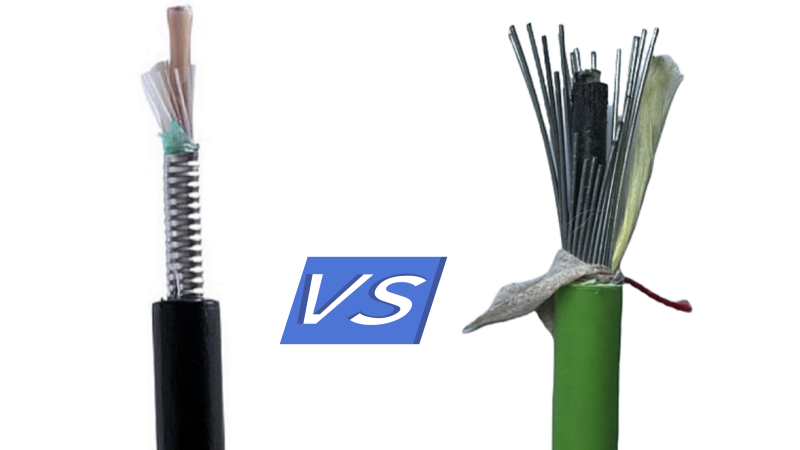
If you’re selecting an armored fiber optic cable, one of the first decisions you’ll face is whether to choose steel wire armor (SWA) or steel tape armor (STA). Both are widely used in cable submarino de fibra óptica projects as well as underground and direct-burial installations, but they are designed to solve different engineering challenges.
Choosing the wrong armor type can lead to installation difficulties, unnecessary costs, or reduced cable reliability over time. A cable that performs well in an underground duct may not be suitable for a river crossing, while a cable designed for high tensile loads may be unnecessary for a standard direct-burial project.
This guide compares steel wire armored and steel tape armored fiber optic cables from a practical engineering perspective. By the end, you’ll understand the strengths, limitations, and ideal applications of each design, making it easier to select the right cable for your project.
Respuesta rápida
If your project involves long pulling distances, directional drilling, bridge crossings, or underwater installations, steel wire armored (SWA) cable is generally the better option because it offers higher tensile strength.
If your project focuses on direct burial, underground ducts, or areas where external pressure is the primary concern, steel tape armored (STA) cable is often a more economical and practical choice.
The table below provides a quick comparison.
| Característica | Armadura de alambre de acero (SWA) | Steel Tape Armor (STA) |
|---|---|---|
| Resistencia a la tracción | ⭐⭐⭐⭐⭐ | ⭐⭐ |
| Resistencia al aplastamiento | ⭐⭐⭐⭐ | ⭐⭐⭐⭐⭐ |
| Flexibilidad | Mejor | Moderado |
| Pulling Performance | Excelente | Moderado |
| Cruce de río | Excelente | Limitado |
| Entierro directo | Excelente | Excelente |
| Underground Duct | Good | Excelente |
| Coste | Más alto | Baja |
What Is Steel Wire Armored Fiber Optic Cable?
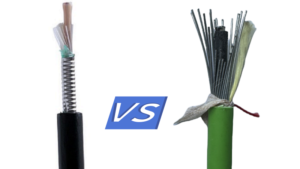
Steel wire armored cable uses multiple galvanized steel wires wrapped around the cable core. These wires are designed to absorb pulling forces during installation while also protecting the cable from mechanical damage.
Because the tensile load is shared across many steel wires, this construction performs particularly well in installations where cables are pulled over long distances or installed in challenging environments.
Aplicaciones típicas incluyen:
- Cruces de río
- Bridge crossings
- Utility tunnels
- Railway communication systems
- Wind farms
- Industrial facilities
For projects requiring high mechanical strength, many engineers specify a steel wire armored fiber optic cable because it provides reliable protection without significantly affecting optical performance.
Structure of a Steel Wire Armored Fiber Optic Cable
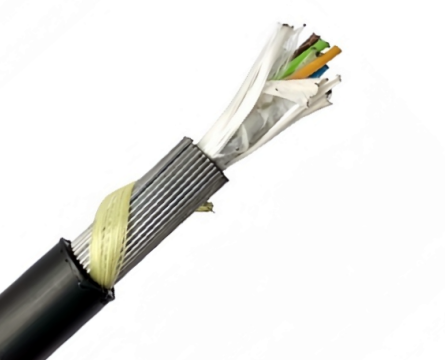
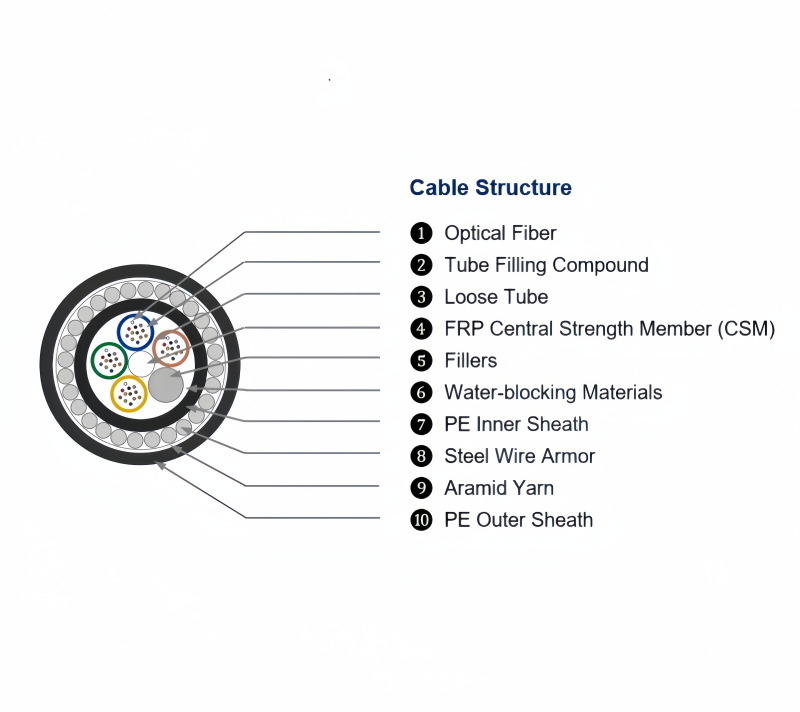
Illustrate:
- Outer PE Jacket
- Galvanized Steel Wires
- Funda interior
- Tubo suelto
- Fibras Ópticas
¿Qué es el cable de fibra óptica blindado con cinta de acero?
Cable de acero blindado con cinta uses a corrugated steel strip instead of individual steel wires. The tape wraps around the cable core to create a continuous protective layer.
Rather than increasing tensile capacity, steel tape mainly improves resistance to crushing, impact, and rodent damage. This makes it a common choice for underground cable installations where external pressure is a greater concern than pulling force.
Aplicaciones típicas incluyen:
- Entierro directo
- Underground duct systems
- Redes de telecomunicaciones urbanas
- Industrial parks
- Campus networks
Compared with steel wire armor, steel tape armor is usually lighter and more cost-effective, making it suitable for many conventional outdoor installations.
Structure of a Steel Tape Armored Fiber Optic Cable
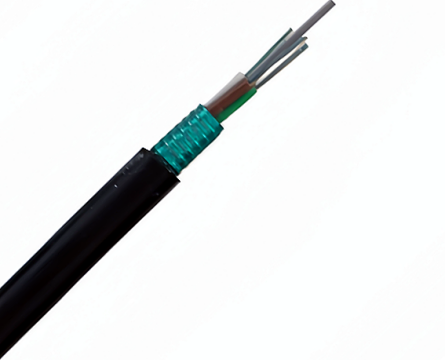
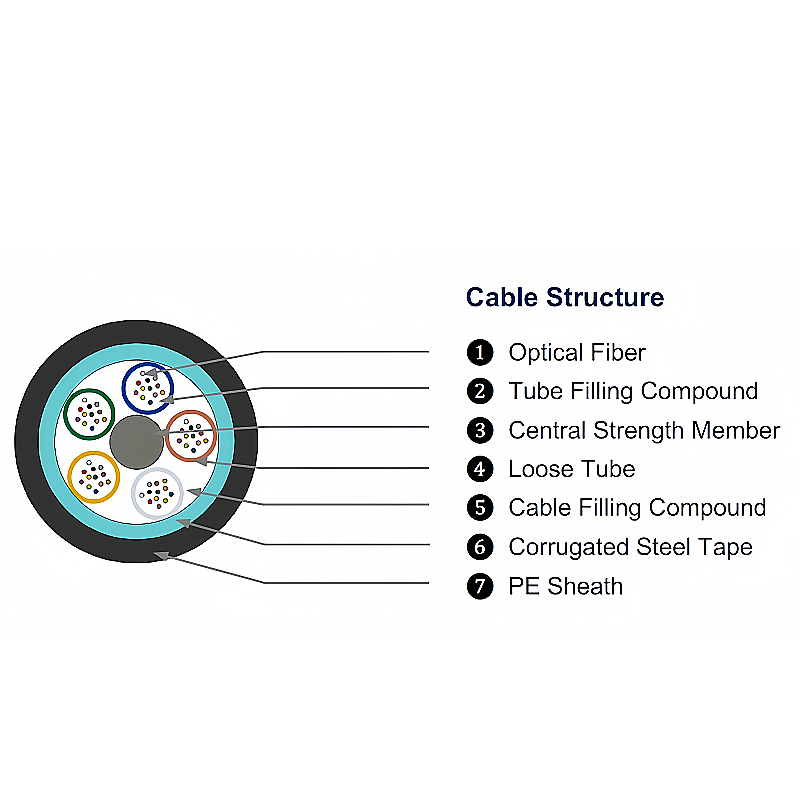
Illustrate:
- Chaqueta de PE
- Cinta de acero corrugado
- Capa de bloqueo de agua
- Tubo suelto
- Fibras Ópticas
Steel Wire Armor vs Steel Tape Armor: Key Differences
Although both cable types are classified as armored fiber optic cables, they are designed to resist different kinds of mechanical stress.
Resistencia a la tracción
Tensile strength refers to the cable’s ability to withstand pulling forces during installation.
This is particularly important for:
- Horizontal directional drilling (HDD)
- Long underground ducts
- Bridge installations
- Cruces de río
Steel wire armor significantly outperforms steel tape armor because each wire shares part of the pulling load. As installation distances increase, this advantage becomes even more important.
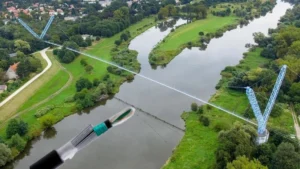
Proyectos que involucran fiber optic cable for river crossings typically prioritize tensile strength over other mechanical properties because installation and future maintenance are more challenging.
Resistencia al aplastamiento
Crush resistance measures how well a cable withstands external pressure after installation.
Typical sources of crushing force include:
- Heavy soil
- Vehicle traffic
- Pavement loading
- Underground infrastructure
- Construction equipment
Because steel tape forms a continuous protective barrier around the cable core, it distributes external pressure more evenly than individual steel wires.
For this reason, STA cable is often preferred in conventional direct-burial projects where crushing loads are expected but tensile stress remains relatively low.
Flexibilidad
Steel wire armored cables generally provide better flexibility during installation, particularly when routing around curves or through long conduit systems.
Steel tape armor tends to be slightly stiffer due to the continuous metal layer, although this difference is usually not significant in shorter installations.
Coste
Steel tape armored cable is generally less expensive to manufacture because it uses less metal and has a simpler construction.
However, selecting a cable based only on initial price can increase lifecycle costs if the installation environment requires greater mechanical protection.
Choosing the right armor should always be based on project conditions rather than material cost alone.
simple comparison chart showing:
| Performance | SWA | STA |
|---|---|---|
| Resistencia a la tracción | ★★★★★ | ★★☆☆☆ |
| Resistencia al aplastamiento | ★★★★☆ | ★★★★★ |
| Flexibilidad | ★★★★☆ | ★★★☆☆ |
| Long Pulling Distance | ★★★★★ | ★★☆☆☆ |
| Underground Burial | ★★★★☆ | ★★★★★ |
Best Applications for Steel Wire Armored and Steel Tape Armored Cables
While both cable types are suitable for outdoor installations, they excel in different environments. Selecting the right armor depends on the primary mechanical risk rather than simply choosing the stronger construction.
| Tipo de proyecto | Recommended Armor | Why |
|---|---|---|
| Entierro directo | Armadura de cinta de acero | Excellent crush resistance and cost efficiency |
| Underground Duct | Armadura de cinta de acero | Protects against soil pressure and external compression |
| Long-Distance Duct Pulling | Armadura de alambre de acero | Higher tensile strength during installation |
| Bridge Crossing | Armadura de alambre de acero | Better resistance to pulling forces and vibration |
| Cruce de río | Armadura de alambre de acero | Handles high tensile loads and harsh environments |
| Utility Tunnel | Either | Depends on pulling distance and mechanical requirements |
| Industrial Plant | Armadura de cinta de acero | Suitable for fixed underground routes |
In practice, there is no universal “best” armor type. The correct choice depends on how the cable will be installed and the conditions it will face throughout its service life.
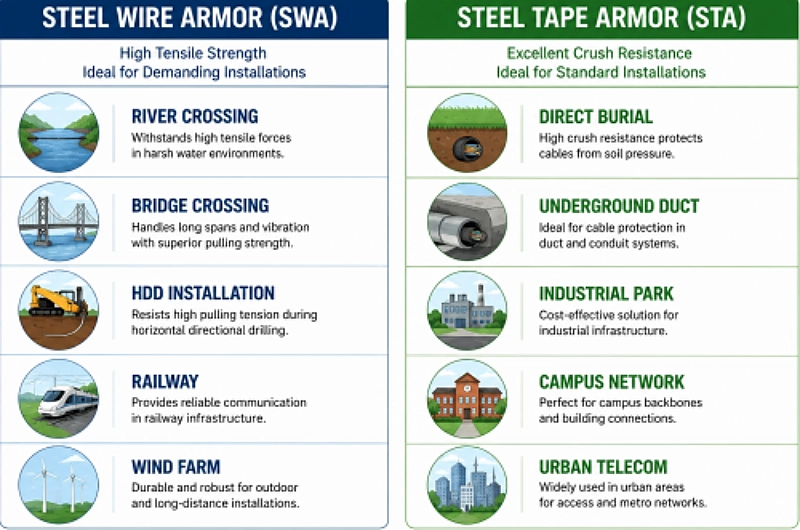
Typical Applications for SWA and STA Fiber Optic Cables
Armadura de alambre de acero (SWA)
- Cruce de río
- Bridge Crossing
- HDD Installation
- Railway
- Wind Farm
Steel Tape Armor (STA)
- Entierro directo
- Underground Duct
- Industrial Park
- Campus Network
- Urban Telecom
Three Common Selection Mistakes
Many installation problems can be traced back to choosing the wrong armor type rather than poor cable quality.
Mistake 1: Choosing Steel Wire Armor for Every Project
Some buyers assume that higher mechanical strength always means a better cable. In reality, using SWA in a simple underground duct project may increase costs without providing meaningful benefits.
Selecting the appropriate armor should always reflect the actual installation environment.
Mistake 2: Ignoring Installation Method
The same cable may perform differently depending on how it is installed.
Por ejemplo:
- A cable installed by horizontal directional drilling experiences high pulling tension.
- A cable buried directly beneath a roadway mainly faces long-term compressive loads.
This is why engineers first evaluate the installation method before choosing the right underwater fiber optic cable for demanding infrastructure projects.
Mistake 3: Focusing Only on Initial Cost
A lower purchase price does not always result in a lower project cost.
Replacing a damaged cable beneath a river or highway is often far more expensive than selecting the appropriate armor during the design stage.
Considering installation, maintenance, and expected service life together usually leads to better long-term value.
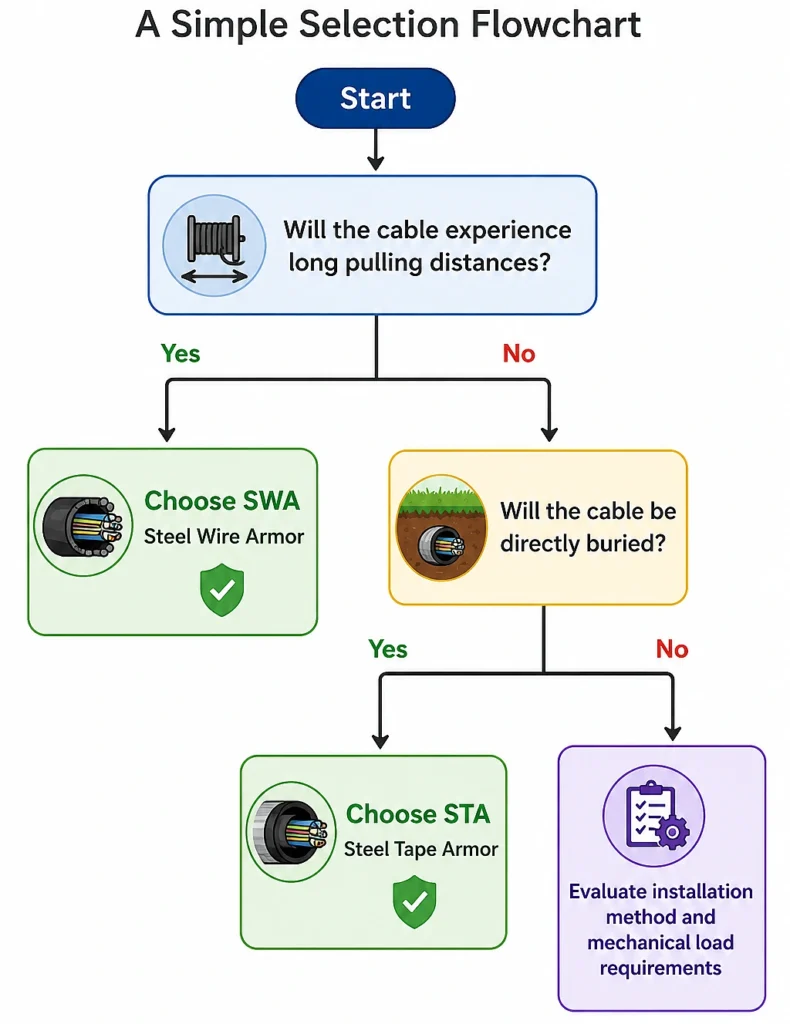
How to Decide Between SWA and STA
If you’re still unsure which armor type fits your project, use the following decision process.
Choose Steel Wire Armor if:
- The cable will be pulled over long distances.
- The project includes river or bridge crossings.
- Horizontal directional drilling (HDD) will be used.
- Higher tensile strength is required.
Choose Steel Tape Armor if:
- The cable will be directly buried.
- Soil pressure is the main concern.
- Installation distances are relatively short.
- Cost efficiency is an important factor.
For projects that involve underwater crossings, engineers often compare single vs double steel wire armor after deciding that steel wire armor is the appropriate construction.
Preguntas frecuentes
Is steel wire armored cable always stronger than steel tape armored cable?
Not necessarily. Steel wire armor provides higher tensile strength, while steel tape armor generally offers better resistance to distributed crushing loads. The better option depends on the installation conditions.
Can steel tape armored cable be used for river crossings?
It can be used in some protected installations, but projects involving long pulling distances or direct underwater exposure usually require stronger tensile performance.
Comprender water blocking technology in fiber optic cables is equally important because moisture protection works together with armor to improve long-term reliability.
Which armor type is more flexible?
Steel wire armored cables are generally easier to pull through long ducts and curved routes because the individual wires distribute stress more effectively during installation.
Which cable costs less?
Steel tape armored cables are usually less expensive than comparable steel wire armored cables due to their simpler construction.
However, total project cost should include installation, maintenance, and expected service life rather than purchase price alone.
Can both cable types be used underground?
Yes. Both SWA and STA are suitable for underground installations. The choice depends on whether tensile strength or crush resistance is the primary design requirement.
Conclusión
Steel wire armored and steel tape armored fiber optic cables are designed to solve different engineering challenges rather than compete as better or worse alternatives.
Steel wire armor is the preferred choice when high tensile strength, long pulling distances, or demanding installation environments are involved. Steel tape armor remains an excellent solution for direct burial and underground duct systems where crush resistance and cost efficiency are the primary considerations.
By evaluating installation methods, mechanical loads, and long-term operating conditions before selecting a cable, engineers can improve network reliability while avoiding unnecessary installation and maintenance costs.


 English
  Español