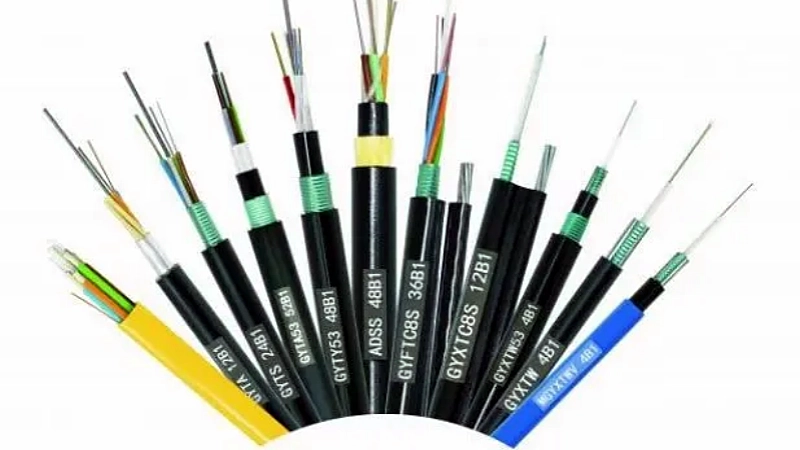
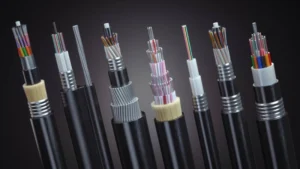
Choosing the right fiber optic cable construction is essential for reliable network performance, long service life, and trouble-free installation. Two cables may use the same optical fiber type and have the same fiber count, but their internal structures can be very different.
The right construction depends on where the cable will be installed, how it will be handled, the mechanical protection required, and the environmental conditions it must withstand.
For example, a duct installation may require a stranded loose tube design, while an indoor connection may benefit from a tight-buffered structure. Direct burial projects may need additional moisture barriers and mechanical protection.
This guide explains the main fiber optic cable construction types, their differences, and how to select a suitable structure for your project.
1. What Is Fiber Optic Cable Construction?
Fiber optic cable construction refers to the arrangement of optical fibers and the protective components surrounding them. Each component has a specific function, such as protecting fibers from moisture, reducing mechanical stress, maintaining cable strength, or providing environmental protection.
For a broader selection process covering installation environment, fiber count, fiber type, and cable specifications, read our guide to choosing the right fiber optic cable for your project.
A typical outdoor fiber optic cable may contain:
- Optical fibers: Transmit optical signals through the cable.
- Loose tubes or tight buffers: Protect optical fibers from external mechanical stress.
- Filling compound or water-blocking materials: Prevent water from spreading along the cable.
- Miembro de fuerza central Provides structural support and helps control cable deformation.
- Aramid yarn or steel wires: Improve tensile strength where required.
- Armadura: Provides additional mechanical protection.
- Inner and outer sheaths: Protect the cable from moisture, abrasion, chemicals, and environmental exposure.
Not every cable contains all these components. Their combination depends on the intended application.
The key is to select a construction that meets the actual installation and operating requirements without adding unnecessary complexity or cost.
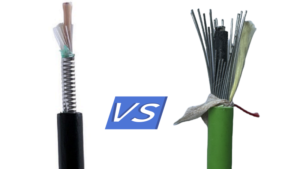
2. Loose Tube vs Tight Buffered Fiber Optic Cable
One of the first decisions is whether to use loose tube or tight-buffered construction.
These two designs protect optical fibers differently and are intended for different installation conditions.
Loose Tube Construction
In loose tube construction, optical fibers are placed inside a protective tube with additional space around them. The tube may contain filling compound or dry water-blocking materials.
This arrangement allows the fibers to move slightly inside the tube when the cable experiences temperature changes or mechanical stress.
Main advantages:
- Reduces stress transferred directly to optical fibers.
- Provides better protection against temperature-related expansion and contraction.
- Supports multi-fiber and high-core-count cable designs.
- Can incorporate water-blocking materials.
- Suitable for many outdoor installations.
Loose tube construction is widely used in duct, aerial, underground, and other outdoor communication networks.
Tight Buffered Construction
In tight-buffered construction, each optical fiber is surrounded by a protective polymer layer that fits closely around the fiber.
The buffer provides additional physical protection and makes individual fibers easier to handle during termination and installation.
Main advantages:
- Easier fiber handling and termination.
- Convenient for indoor distribution and equipment connections.
- Suitable for patch cords, breakout cables, and indoor cable assemblies.
- Provides additional protection during frequent handling.
However, tight-buffered fibers are generally more sensitive to temperature-related mechanical effects than appropriately designed loose tube constructions.
¿Cuál elegir?
| Selection factor | Tubo suelto | Tight Buffered |
|---|---|---|
| Typical application | Outdoor networks | Indoor networks |
| Fiber protection | Tube-based protection | Close-fitting buffer |
| Temperature variation | Suitable for wider outdoor conditions | Depends on cable design |
| Fiber handling | Requires tube access | Easier individual handling |
| High fiber counts | Commonly used | Depends on cable design |
| Typical applications | Duct, aerial, buried | Indoor distribution, breakout |
Practical recommendation: Choose loose tube construction for most outdoor backbone and access networks. Choose tight-buffered construction when easy fiber handling, termination, and indoor installation are the main priorities.
3. Central Tube vs Stranded Loose Tube Construction
For outdoor loose tube cables, another important decision is whether to use a central tube or stranded loose tube construction.
Central Loose Tube Construction
In a central loose tube cable, all optical fibers are placed inside one central protective tube. Strength members and other protective components are arranged around the tube.
This design is relatively simple and compact.
Ventajas:
- Simple cable structure.
- Relatively small cable diameter.
- Lightweight design.
- Convenient for low and medium fiber counts.
- Can reduce material usage and manufacturing complexity.
Central tube cables are commonly considered for access networks, distribution networks, and applications where a compact cable structure is preferred.
Construcción de tubo holgado trenzado
In stranded loose tube construction, multiple loose tubes are arranged around a central strength member, usually following a helical or SZ-stranding arrangement.
Each tube can contain several optical fibers, allowing the cable to support higher fiber counts.
Ventajas:
- Supports higher fiber counts.
- Provides flexible cable design.
- Allows different fiber groups to be organized into separate tubes.
- Suitable for backbone and distribution networks.
- Can accommodate additional mechanical protection layers.
Stranded loose tube construction is widely used in outdoor communication networks where higher capacity and mechanical performance are required.
Central Tube vs Stranded Loose Tube
| Factor | Central Tube | Stranded Loose Tube |
|---|---|---|
| Estructura | One central tube | Multiple tubes around a central member |
| Capacidad de fibra | Usually lower | Can support higher counts |
| Cable diameter | Often smaller | Depends on tube count and design |
| Peso del cable | Often lighter | Usually higher for comparable protection |
| Manufacturing | Simpler | Más complejo |
| Typical use | Access and distribution | Backbone and high-capacity networks |
The choice should not be based on fiber count alone. Cable diameter, installation conditions, tensile requirements, crush resistance, and future expansion should also be considered.
4. How to Choose the Strength Member
Strength members help protect optical fibers from excessive tensile stress during installation and operation.
The two common materials are FRP and steel.
FRP Strength Member
FRP stands for Fiber Reinforced Plastic. It is a non-metallic material commonly used as a central strength member in all-dielectric fiber optic cables.
Its advantages include:
- No electrical conductivity.
- No electromagnetic interference.
- Lightweight construction.
- Corrosion resistance.
- Suitable for applications requiring all-dielectric cable designs.
FRP is frequently used in ADSS cables and other non-metallic outdoor cable constructions.
Steel Strength Member
Steel strength members provide high mechanical strength and are used when additional tensile performance is required.
Depending on the cable design, steel may be used as a central member, steel wire armor, or another reinforcing component.
Its advantages include:
- High tensile strength.
- Strong mechanical support.
- Suitable for demanding installation conditions.
- Can provide additional protection against mechanical damage when designed as armor.
However, steel adds weight and may introduce electrical and corrosion considerations.
How to choose: FRP is suitable when electrical isolation, lightweight construction, and corrosion resistance are important. Steel is worth considering when the project requires higher mechanical strength or additional armor protection.
5. How to Choose the Right Water-Blocking Construction
Moisture protection is one of the most important considerations for outdoor fiber optic cables.
Water entering a cable can travel along its internal structure, potentially causing damage to cable components and affecting long-term reliability.
There are two common approaches to water blocking.
Gel-Filled Construction
Traditional loose tube cables often use water-blocking filling compound inside the loose tubes. Some designs also use filling compound in the cable core.
The compound helps prevent water from moving along the cable.
Las ventajas incluyen:
- Effective moisture protection.
- Established construction technology.
- Suitable for many outdoor applications.
- Proven performance in conventional cable designs.
The main disadvantage is that gel can make cable preparation and cleaning more difficult during installation and maintenance.
Dry Water-Blocking Construction
Dry water-blocking cables use materials such as water-blocking yarn, tape, or other swellable components.
When exposed to water, these materials expand and help block its movement.
Las ventajas incluyen:
- Cleaner cable preparation.
- Easier handling during splicing.
- Reduced use of filling compound.
- Convenient installation and maintenance.
However, dry water-blocking performance depends on the material, placement, and overall cable design.
Which Water-Blocking Design Is Better?
Neither construction is automatically better for every project.
The correct selection depends on:
- Underground or aerial installation conditions.
- Expected moisture exposure.
- Required water penetration resistance.
- Installation and maintenance practices.
- Applicable project specifications.
For underground and direct burial projects, specify the required longitudinal water penetration performance rather than simply requesting a gel-filled or dry cable.
6. When Do You Need Armored Fiber Optic Cable?
Armor is an additional protection layer designed to improve mechanical resistance.
Depending on the construction, it may use corrugated steel tape, steel wires, or other protective materials.
Las opciones más comunes son:
Steel Tape Armor: Corrugated steel tape provides additional protection against crushing and mechanical damage. It is commonly used in outdoor and underground cable designs.
Steel Wire Armor: Steel wires provide additional tensile and mechanical protection. This construction is often considered for demanding installations where pulling forces or external mechanical risks are higher.
Non-Armored Construction: Uses other protective components, such as strength members and outer sheaths, without a metallic armor layer.
Armor selection should depend on actual project risks, including external pressure, impact, rodents, installation method, and pulling conditions.
For example, a cable installed inside a protected duct may not need the same armor as a cable installed directly underground.
For a more detailed comparison of protection requirements, see our guide to when to use armored or non-armored fiber optic cable.
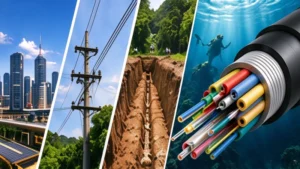
7. Match Cable Construction to the Installation Environment
The installation environment should be one of the first factors considered when selecting cable construction.
Here are some typical engineering recommendations.
| Entorno de instalación | Common construction considerations |
|---|---|
| Duct installation | Loose tube, suitable pulling strength, friction and crush resistance |
| Aerial installation | ADSS or self-supporting construction, suitable tensile performance and UV-resistant sheath |
| Entierro directo | Loose tube, water blocking, suitable armor and moisture protection |
| Indoor installation | Tight-buffered or indoor-rated cable, appropriate fire performance |
| Underwater installation | Water-blocking structure, moisture barriers, suitable tensile and pressure resistance |
For example, an aerial self-supporting cable may use a central loose tube, parallel FRP strength members, water-blocking materials, and a PE outer sheath. This construction helps provide lightweight support for aerial distribution networks.
For a real example, you can review our aerial flat self-supporting fiber cable design.
For more demanding applications, a cable may combine stranded loose tubes, corrugated steel tape, steel wire armor, and double PE sheaths. Such a design provides additional mechanical and moisture protection.
See our stranded loose tube steel wire armored cable structure for a practical example.
You can also explore our outdoor fiber optic cable solutions for different installation conditions to compare available cable designs.
8. Common Mistakes When Selecting Fiber Optic Cable Construction
Even when the fiber type and fiber count are correct, an unsuitable cable construction can create installation and maintenance problems.
Avoid these common mistakes:
1. Choosing based only on fiber count
A 48-fiber cable does not automatically require the same construction as another 48-fiber cable. Installation conditions and mechanical requirements are equally important.
2. Using indoor construction outdoors
Indoor cables may not provide the moisture resistance, UV protection, or temperature performance required for outdoor installations.
3. Assuming all loose tube cables are the same
Central tube and stranded loose tube designs have different structures, capacities, and mechanical characteristics.
4. Adding armor without evaluating the project
Armor increases cable weight, diameter, and material cost. It should be selected according to actual mechanical risks.
5. Ignoring installation requirements
A cable that meets optical requirements may still be unsuitable if its tensile strength, bending radius, or crush resistance does not meet the installation specification.
6. Focusing only on the material list
The complete cable construction must work as a system. Strength members, water-blocking materials, armor, and outer sheaths should be compatible with the intended application.
9. What Information Should You Provide When Ordering a Fiber Optic Cable?
When requesting a quotation, providing clear technical requirements helps manufacturers recommend the right construction and avoid unnecessary design changes.
We recommend preparing the following information:
| Requisito | Information to provide |
|---|---|
| Fiber type | G.652.D, G.657.A, OM3, OM4, etc. |
| Recuento de fibras | 12F, 24F, 48F, 96F, 144F, etc. |
| Método de instalación | Duct, aerial, direct burial, indoor, underwater |
| Cable construction | Central tube, stranded loose tube, tight buffer |
| Strength member | FRP, steel wire, or other specified material |
| Water blocking | Gel-filled, dry water-blocking, or project-specific design |
| Armadura | Steel tape, steel wire, or non-armored |
| Outer sheath | PE, LSZH, PVC, or other specified material |
| Mechanical requirements | Tensile strength, crush resistance, bending radius |
| Project quantity | Total cable length and required drum length |
If you have an existing cable drawing, technical datasheet, or tender specification, sharing it with the manufacturer is often the easiest way to confirm the correct construction.
At HONELINKS, we manufacture fiber optic cables for different network applications and can discuss construction details according to project requirements.
Preguntas frecuentes
1. What is the difference between loose tube and tight buffer fiber optic cable?
Loose tube cables place optical fibers inside protective tubes with space around the fibers, helping isolate them from external mechanical and temperature-related stress. Tight-buffered cables have a protective polymer layer closely surrounding each fiber, making individual fiber handling and termination easier.
2. Which fiber optic cable construction is best for outdoor use?
Loose tube construction is commonly used for outdoor networks because it provides flexible fiber protection and can incorporate water-blocking materials, strength members, armor, and weather-resistant sheaths. The exact design depends on the installation environment.
3. What is the difference between central tube and stranded loose tube cable?
Central tube cables place the fibers in one central tube, while stranded loose tube cables arrange multiple tubes around a central strength member. Central tube designs are often more compact, while stranded designs are commonly used for higher fiber counts.
4. Is FRP better than steel for fiber optic cable strength members?
Neither material is universally better. FRP is lightweight, non-conductive, and corrosion-resistant. Steel provides high mechanical strength but adds weight and requires appropriate electrical and corrosion considerations.
5. Does every outdoor fiber optic cable need armor?
No. Some outdoor cables use non-metallic strength members and protective sheaths without armor. Armor is selected according to mechanical risks, installation conditions, and project specifications.
6. Can fiber optic cable construction be customized?
Yes. Manufacturers can adjust the number of loose tubes, fiber arrangement, strength members, water-blocking materials, armor, and sheath materials to meet specific project requirements, subject to design feasibility and applicable standards.
Conclusión
Choosing the right fiber optic cable construction requires more than selecting loose tube or tight buffer, or deciding whether to use armor.
The correct design must match the installation environment, fiber capacity, mechanical requirements, moisture exposure, and long-term operating conditions.
Before ordering, confirm the cable structure, strength member, water-blocking system, armor requirements, and outer sheath with your manufacturer.
If you have a project specification or an existing cable drawing, contact HONELINKS with your technical requirements. Our team can help evaluate a suitable fiber optic cable construction for your application.


 English
 Español