Direct Burial Fiber Optic Cable Manufacturer

Reliable Underground Fiber Optic Cable Solutions for Long-Term Outdoor Network Deployment
underground fiber optic cable

Choose The Right Direct Burial Fiber Optic Cable

Choose the right direct burial fiber optic cable for your underground network deployment. From double armored backbone cables to compact access network solutions, our underground fiber cables are engineered for long-term outdoor performance, moisture resistance, and reliable mechanical protection in harsh installation environments.

Single Armored Underground Cable GYTA

Choose This When:

Choose for 12–96 core outdoor and light underground networks where lower cost and good moisture protection are priorities.

Not Recommended For:

Heavy direct burial, rocky soil, or high crush-risk environments.

Steel Tape Armored Underground Fiber Optic Cable GYTS

Choose This When:

Choose for 12–144 core underground installation requiring better crush resistance and rodent protection than aluminum tape structures.

Not Recommended For:

Heavy-duty long-term direct burial with very high mechanical stress.

Double Jacket Double Armored Cable GYTA53

Choose This When:

Choose for 24–288 core telecom backbone and direct burial projects requiring strong moisture, crush, and rodent protection.

Not Recommended For:

Small fiber count access networks or installations requiring compact cable size.

Heavy-Duty Direct Burial Fiber Optic Cable GYTS53

Choose This When:

Choose for 24–288 core harsh underground environments requiring maximum mechanical durability and long-term direct burial reliability.

Not Recommended For:

Short-distance or low-risk underground installations with limited budget.

SWA Loose Tube Fiber Optic Cable

Choose This When:

Choose for medium or high fiber count industrial underground projects requiring very high tensile strength and mechanical protection.

Not Recommended For:

Standard telecom underground projects where steel tape armor is sufficient.

SWA Tight Buffered Fiber Cable

Choose This When:

Choose for low fiber count industrial and harsh environments requiring flexible installation and indoor/outdoor transition capability.

Not Recommended For:

Large fiber count outdoor backbone and long-distance underground networks.

Not Sure Which cable is right for your project?learn More Here:

Applications of Direct Burial Fiber Optic Cable

Direct burial fiber optic cables are widely used in underground communication networks where conduit systems are not available or long-term underground durability is required. Their armored structures provide strong protection against moisture, pressure, and harsh outdoor environments.

Telecom backbone networks

Long-distance underground transmission

Metro backbone deployment

High fiber count communication


FTTx & Broadband Networks

FTTH underground access
Residential broadband
Rural fiber deployment

ISP Underground Infrastructure

Urban underground routing
Suburban network expansion
Underground broadband deployment

Smart City Infrastructure

Traffic monitoring systems
Surveillance networks
Public communication infrastructure

Industrial & Transportation Networks

Factory communication systems
Railway communication
Highway monitoring networks

Not sure which direct burial fiber optic cable to choose?

Why Choose Our Direct Burial Fiber Optic cable?

We are a professional fiber optic cable manufacturer with over 23 years of experience, serving telecom operators, contractors, and distributors worldwide.

Built for compatibility, performance, and long-term reliability.

fiber optic cable factory

High-Quality Manufacturing

Advanced production, strict quality control, and international certifications (ISO, CE, RoHS, UL).

Fiber optic cable

Customization & Flexibility

Tailor-made fiber cables, OEM/ODM services, and diverse product options.

Bulk fiber optic cable

Competitive Pricing

Factory-direct supply with cost-effective solutions and bulk discounts.

Weixin Image_20241021103401_副本

Fast Delivery & Reliable Supply

Efficient production, stable raw materials, and global logistics support.

23+ Years Experience   |   1000+ Clients   |   100% Tested   |   Global Shipping

Looking For A Reliable Burial Fiber Optic Cable Supplier?

Contact us today for pricing, compatibility support, and OEM services.

Structure & Technical Features of Direct Burial Fiber Optic Cable

Direct burial fiber optic cables use armored structures, water-blocking materials, and durable outer jackets to provide reliable underground performance, moisture protection, crush resistance, and long-term outdoor durability.

Single Armored Stranded Loose Tube Cable GYTA / GYTS

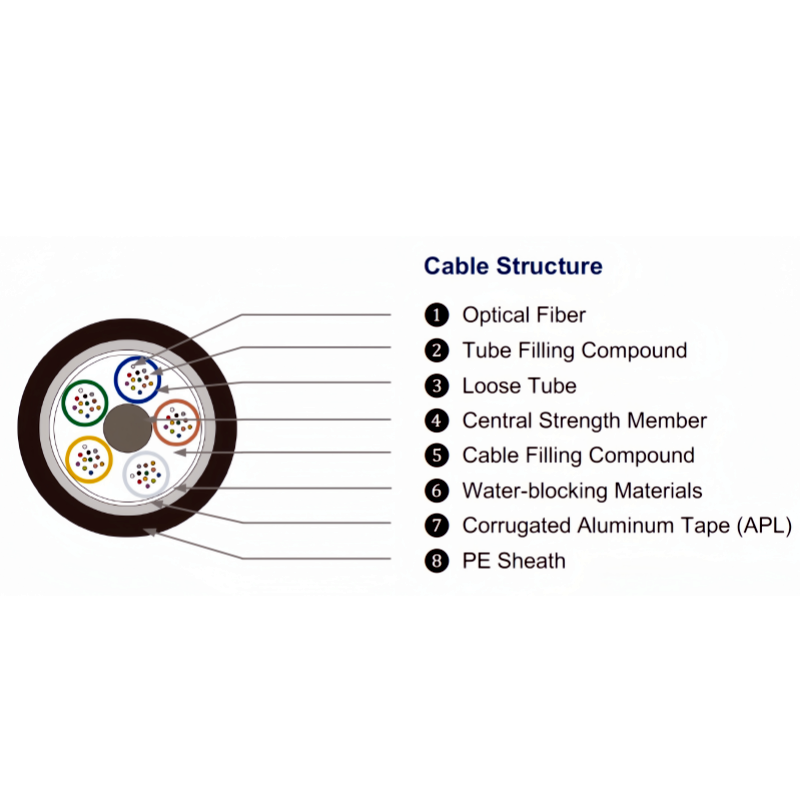
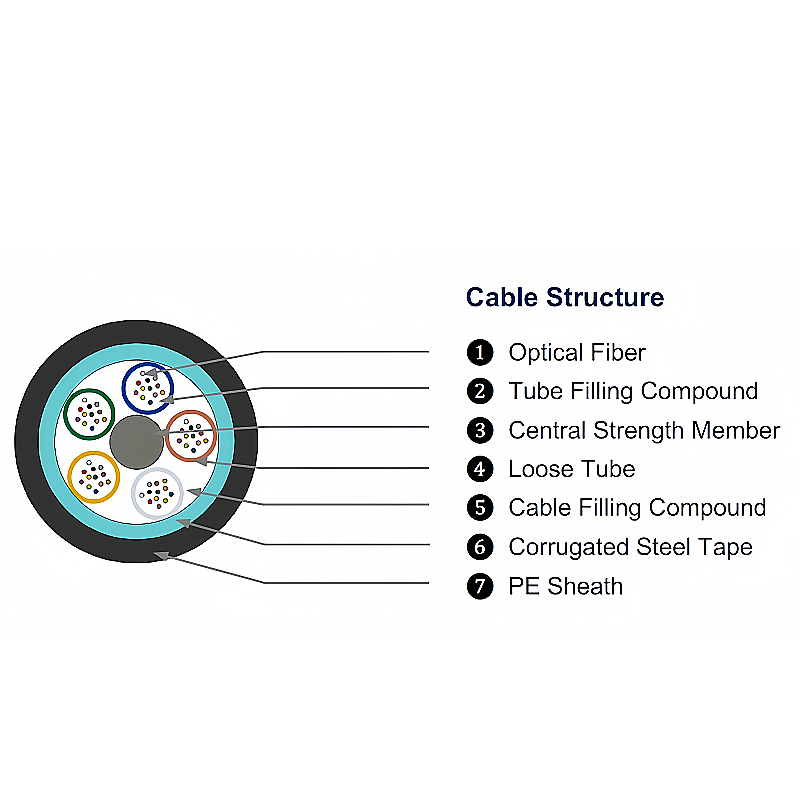
Stranded loose tube outdoor cable with single aluminum tape or steel tape armor, designed for basic moisture resistance and moderate mechanical protection. GYTS provides stronger crush resistance than GYTA. Duct installation, light underground deployment, outdoor communication lines, metropolitan access networks, and standard ISP infrastructure projects.

Double Jacket Double Armored Cable GYTA53 / GYTS53

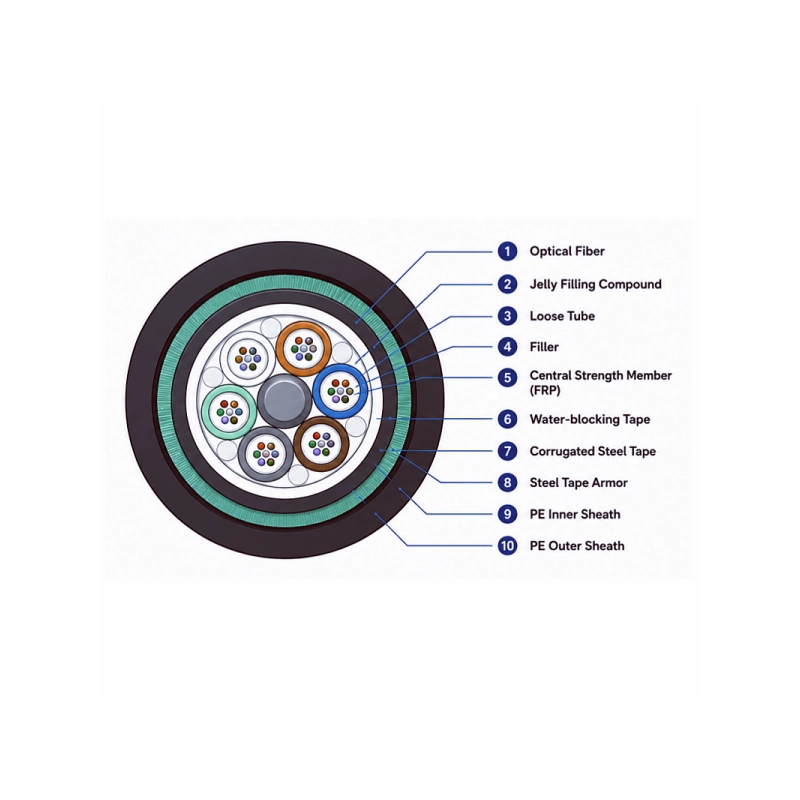
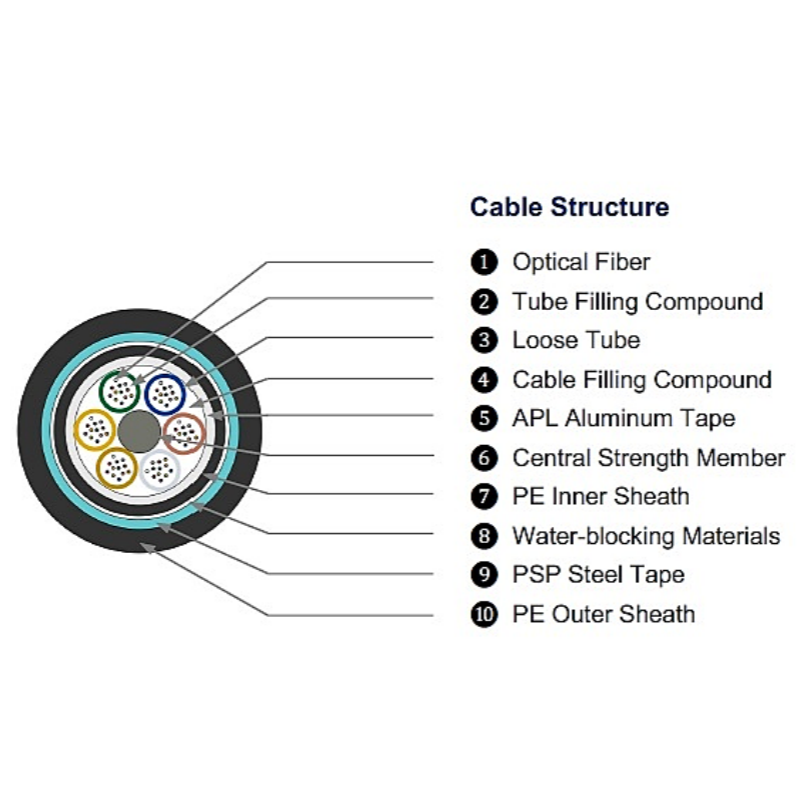
Double PE sheath with corrugated steel tape armor structure providing enhanced moisture blocking, crush resistance, rodent protection, and long-term underground durability. GYTS53 offers stronger mechanical protection for harsher environments. Direct burial telecom backbone networks, underground broadband infrastructure, long-distance outdoor communication systems, and harsh underground installation environments.

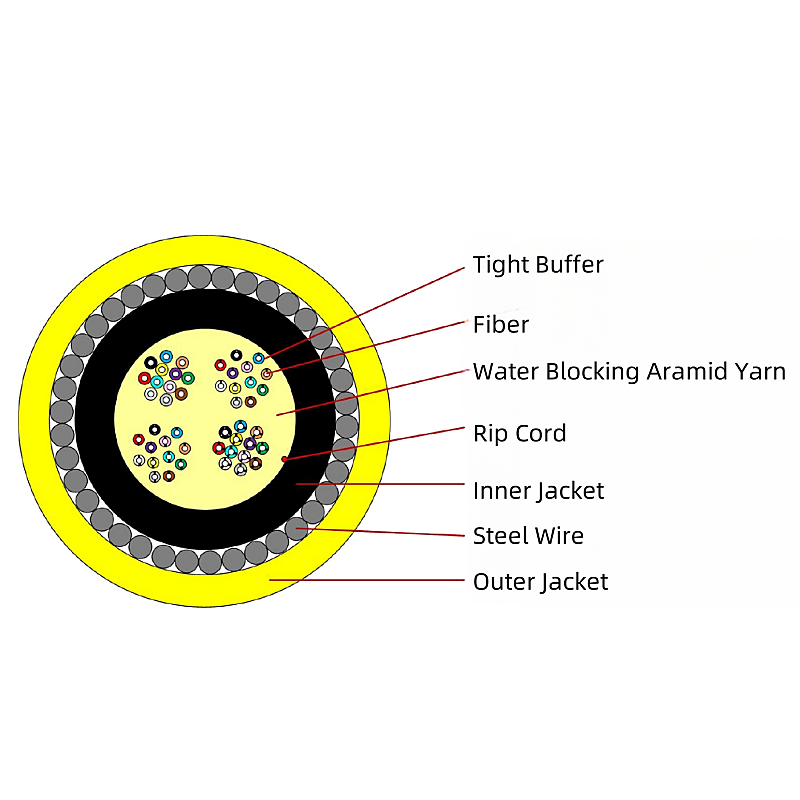
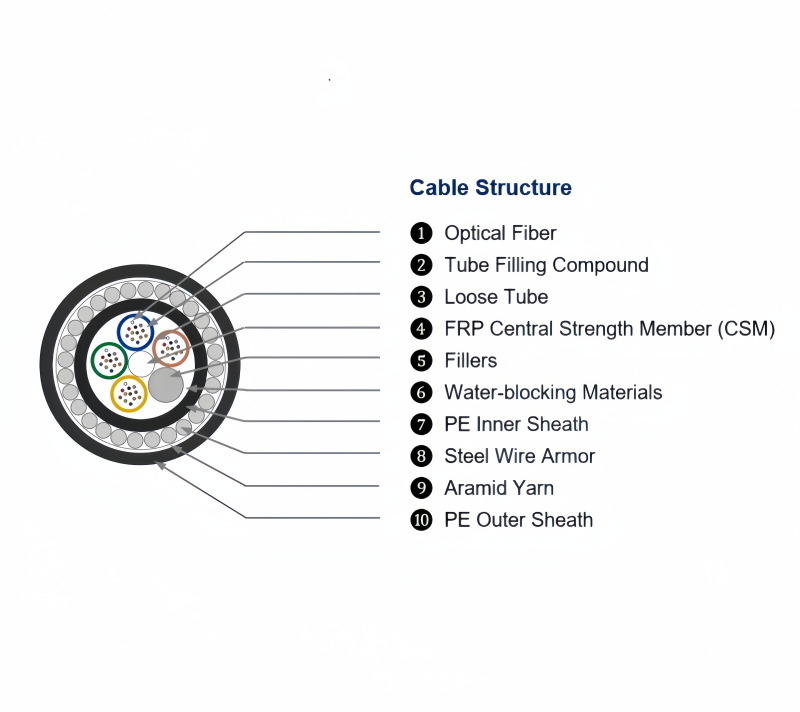
Steel Wire Armored Cable SWA Loose Tube / SWA Tight Buffered Fiber Cable

Heavy-duty steel wire armor structure designed for very high tensile strength and mechanical durability. Tight buffered versions provide better flexibility and easier field termination for industrial installation. Industrial communication systems, mining projects, railway infrastructure, factory networks, military communication, and harsh outdoor or underground environments requiring heavy-duty cable protection.

Environmental & Mechanical Performance

Direct burial fiber optic cables are designed to withstand underground pressure, moisture, temperature changes, and harsh outdoor environments. Armored structures and durable PE jackets provide stable long-term performance, high crush resistance, rodent protection, and reliable mechanical strength for underground network deployment.

How to Choose the Right Direct Burial Fiber Optic Cable

Choosing the right direct burial fiber optic cable depends on the underground environment, mechanical protection requirements, network type, and future expansion needs. Different cable structures are designed for different installation conditions, helping ensure reliable long-term underground network performance.

Installation Environment

The underground installation environment is one of the most important factors when selecting direct burial fiber optic cable. Soil conditions, mechanical pressure, moisture levels, and installation distance all affect cable durability and long-term outdoor performance.

Rocky Soil or harsh terrain

rocky soil or harsh terrain
gyts53 stranded loose tube steel tape double armored fiber optic cable
GYTS53 Cable

High Moisture Area

high moisture underground environment
gyta53 stranded loose tube aluminum steel tape double sheath armored fiber optic cable
GYTA53 Cable

Long-Distance Backbone

need long distance underground deployment
gyta53 & gyts53
GYTS53 & GYTA53

Limited Installation Space

limited trench space
gyxtw53 central uni tube steel tape double armored fiber optic cable
GYXTW53

Mechanical Protection Requirements

Different underground projects require different levels of crush resistance, tensile strength, and rodent protection. Choosing the correct armored structure helps ensure safe installation and long-term network reliability.

Standard Underground Protection

Cost-effective underground armored structure

gyta stranded multi loose tube aluminum tape light armored fiber optic cable
GYTA Cable

High Crush Resistance

Double armored structure for harsh underground conditions

gyts53 stranded loose tube steel tape double armored fiber optic cable
GYTA53

High Tensile Strength

Steel wire armor for difficult pulling environments

swa fiber optic cable feature picture
SWA Cable

Compact & Lightweight

Small-size underground cable for access networks

gyxtw central uni tube steel tape light armored fiber optic cable
GYXTW

Network Type

The cable structure should also match the network architecture. Backbone networks, access systems, and industrial communication projects require different underground cable designs.

Backbone network

High fiber count underground communication systems

gyta53 & gyts53
GYTA53 / GYTS53

FTTx Deployment

Compact underground access network installation

gyxtw & gyxtw53
GYXTW / GYXTW53

Industrial Network

Heavy-duty armored protection for harsh environments

steel wire armored tight buffer cable
SWA Tight Buffered Cable

Rural broadband

Cost-effective underground outdoor deployment

gyts stranded loose tube steel tape light armored fiber optic cable
GYTS Cable

Future Expansion & Budget

Future scalability and installation cost should also be considered when selecting direct burial fiber optic cable. Some projects focus on lower deployment cost, while others prioritize long-term durability and future network expansion.

Plan for Future Expansion

Choose higher fiber count stranded loose tube cables for easier future network upgrades.

Budget-sensitive project?

Choose single armored cables for balanced performance and lower installation cost.

Need long service life?

Choose double jacket armored cables for better underground durability and protection.

Need easier future maintenance?

Choose compact and standard underground cable structures for simpler installation and repair.

Not sure which Direct Burial fiber optic cable fits your project? Our engineers can help you select the right structure based on span length, installation environment, and network requirements.

Beyond Direct Burial Systems: Fiber Optic Cable Installation Methods

While direct burial fiber optic cables are ideal for underground deployment without conduit, not all projects are suitable for direct buried installation. Depending on the installation environment, network structure, and maintenance requirements, you may also need duct fiber optic cable, aerial fiber optic cable, or submarine fiber optic cable for your project.  Contact us for more details now!

duct fiber optic cable icon

Duct Fiber Optic Cable

Installed inside conduits, allowing easy maintenance, simplified access, and convenient future upgrades.

Best for

Urban networks, FTTH,backbone projects

direct buried fiber cable icon

Direct Buried Fiber Cable

Installed directly underground without conduits,requiring stronger protection.

Best for

Rural areas,long distance,no duct available

aerial fiber cable icon

Aerial Fiber Optic Cable

Installed on poles or towers,suitable for fast deployment in rural or remote areas.

Best for

Rural areas,power lines,long span applications

submarine fiber cable icon

Submarine Fiber Optic Cable

Designed for underwater deployment with multiple layers of protection for enhanced durability.

Best for

Cross-river, offshore & international networks

Direct Burial Fiber Optic Cable FAQ & Knowledge Center

Find answer to common questions about direct burial fiber optic cables,installation,customization,and more.If you can’t find the answer you need,feel free to contact us!

Frequently Asked Questions 1

What is direct burial fiber optic cable?

Short Answer

Direct burial fiber optic cable is designed for underground installation without conduit protection.

Expanded Answer

These underground fiber optic cables use armored structures, water-blocking materials, and durable PE outer jackets to withstand moisture, underground pressure, and harsh outdoor environments. In large outdoor telecom projects, engineers often select different cable structures based on fiber count, soil conditions, and mechanical protection requirements explained in underground fiber optic cable deployment systems.

What is the difference between direct buried and duct fiber optic cable?

Short Answer

Direct buried cable is installed directly into soil, while duct cable is installed inside conduit systems.

Expanded Answer

Direct burial fiber optic cable requires stronger crush resistance, moisture protection, and rodent protection because the cable is exposed directly to underground pressure. During network planning, contractors often compare installation cost, maintenance access, and protection requirements between direct buried vs duct fiber optic cable deployment methods.

How deep should underground fiber optic cable be buried?

Short Answer

Burial depth depends on local standards, soil conditions, and installation environments.

Expanded Answer

Most underground fiber optic cable installations require sufficient trench depth to protect the cable from surface pressure, construction damage, and environmental changes. Road crossings, rocky soil, and heavy traffic areas usually require deeper trench protection according to recommendations in underground fiber burial depth guide standards.

Why do underground fiber optic cables use steel tape armor?

Short Answer

Steel tape armor improves underground mechanical protection and cable durability.

Expanded Answer

Steel tape armored fiber optic cable provides stronger crush resistance, rodent protection, and underground mechanical stability for direct burial applications. Backbone telecom networks and harsh outdoor installations commonly use protection structures introduced in steel tape armored fiber cable designs.

How can underground fiber optic cable be protected from rodents?

Short Answer

Armored cable structures are commonly used to reduce rodent damage.

Expanded Answer

Steel tape armor, steel wire armor, and double jacket cable structures help improve underground rodent protection in outdoor fiber optic networks. Industrial sites, rural underground routes, and utility networks often follow recommendations for fiber cable rodent protection when selecting armored cable structures.

Frequently Asked Questions 2

Which jacket material is better for underground fiber cable, LSZH or PE?

Short Answer

PE jackets are more commonly used for underground outdoor installation.

Expanded Answer

PE outer jackets provide excellent moisture resistance, UV resistance, and long-term underground durability, while LSZH jackets are more suitable for indoor or fire-sensitive environments. Material selection in LSZH vs PE jacket applications usually depends on installation environment, safety requirements, and outdoor exposure conditions.

What affects underground fiber optic cable installation cost?

Short Answer

Installation cost depends on trenching conditions, cable structure, distance, and labor requirements.

Expanded Answer

Rocky soil, road crossings, installation depth, armored cable structures, and long-distance deployment can significantly increase underground fiber optic cable installation cost. Contractors evaluating underground fiber installation cost also consider restoration work, conduit systems, and future maintenance requirements.

Why is bending radius important for underground fiber optic cable?

Short Answer

Improper bending radius can damage optical fibers and reduce network performance.

Expanded Answer

During underground installation, excessive cable bending may increase optical attenuation or damage internal fiber structures. Large fiber count cables and armored underground cables usually require larger bending radius values defined in underground fiber cable bending radius recommendations.

How should underground fiber optic cable be tested after installation?

Short Answer

Underground fiber optic cable should be tested before network commissioning.

Expanded Answer

OTDR testing, insertion loss testing, and continuity checks help verify underground cable integrity and installation quality after trenching and backfilling. Telecom contractors typically perform procedures outlined in underground fiber testing after installation processes before final network activation.

What are the most common failures in underground fiber optic systems?

Short Answer

Moisture damage, rodent attacks, and improper installation are common underground fiber failures.

Expanded Answer

Poor trench construction, insufficient protection, excessive cable tension, and water ingress can reduce underground fiber optic cable lifespan and network reliability. Many long-term maintenance problems discussed in common failures in underground fiber systems are caused by incorrect installation practices and improper cable selection.

Choosing the appropriate underground direct burial fiber optic cable is essential for optimizing network performance, reducing installation costs, and supporting future expansion in telecom and infrastructure projects.

Still Have Questions?

Contact our technical team for compatibility support and product recommdations

Direct Burial Fiber Optic Cable Knowledge Hub

Practical guides and expert insights on direct burial fiber optic cable selection, installation, and applications.

underground fiber optic cable

Underground & Direct Burial Fiber Optic Cable Guide

Choosing the right underground fiber optic cable can be confusing. This guide explains direct burial cable structures, armored protection, installation environments, and how to select the right cable for long-term outdoor performance.

duct vs direct buried fiber optic cable

Direct Buried vs Duct Fiber Optic Cable

Not sure whether to use direct buried or duct fiber optic cable? This guide compares installation methods, maintenance, project cost, and underground protection to help you choose the right solution.

what is steel tape armored fiber optic cable

Steel Tape Armored Fiber Cable for Direct Burial Installation

Underground fiber cable can fail quickly without proper protection. Learn when steel tape armored fiber cable is needed for crush resistance, rodent protection, and harsh underground environments.

how to protect fiber optic cable from rodents

How to Protect Direct Burial Fiber Cable from Rodents

Rodent damage is one of the most common causes of underground fiber failure. This article explains practical ways to improve rodent protection using armored cable structures and proper installation methods.

lszh vs pe jacket for underground fiber optic cable

LSZH vs PE Jacket for Direct Burial Fiber Optic Cable

Choosing the wrong cable jacket can shorten underground cable lifespan. Compare LSZH and PE jacket materials to understand which one performs better in outdoor and direct burial environments.

underground & direct burial fiber cable installation cost

Underground & Direct Burial Fiber Cable Installation Cost

Underground fiber installation cost depends on much more than cable price. Learn how trenching conditions, cable structure, labor, and deployment distance affect total project cost.

Get Start Now !

Inquire Directly From Direct Burial Fiber Cable Manufacturer

We provide reliable direct burial fiber optic cable solutions for telecom networks, FTTH deployments, and large-scale infrastructure projects worldwide. With years of manufacturing experience and strict quality control, our products ensure stable performance and long service life in various installation environments.

  • Factory-direct pricing for cost-effective bulk orders
  • Custom solutions tailored to your specific project requirements
  • Fast production and delivery to meet tight deadlines
  • Consistent quality backed by professional technical support
  • Suitable for diverse applications including urban, rural, and backbone networks


Your email information will be kept strictly confidential and our business staff will ensure that your private information is absolutely safe!

Ask For Quote Now!

REPLY WITHIN 24 HOURS

REQUEST A QUOTE

Leave your inquiry here! Will respond with technical support and pricing within 24 hours.

Leave your Questions

will respond with technical support and pricing within 24 hours.

tony lau

Hi, I’m Tony Lau 😊

I’m the technical engineer and website administrator of our company, with over 14 years of experience in the fiber optic industry.

If you have any questions about fiber optic cables or FTTH solutions, feel free to leave a comment—I’m happy to help.

Stay Connected With Us!

Get the latest updates on fiber optic solutions, exclusive offers, and expert insights.